All posts by Bobby Franklin

“The Pianist of Willesden Lane” Returns To Hartford Stage

Piano Virtuoso Mona Golabek Returns to Hartford Stage for a Limited Engagement of The Pianist of Willesden Lane

Back by popular demand, the inspirational solo show will run July 12 – 22 for 13 performances.

World-renowned piano virtuoso Mona Golabek returns to Hartford Stage for a limited engagement of her inspirational show, The Pianist of Willesden Lane. Back by popular demand, The Pianist of Willesden Lane will run Thursday, July 12, through Sunday, July 22, for 13 performances only. Tickets will be available for sale on Saturday, May 19.

“Mona’s performance is fondly remembered by Hartford Stage audiences, and I am frequently asked when she might return to Hartford,” said Michael Stotts, Managing Director of Hartford Stage. “We are all delighted to get this chance to welcome Mona back this summer, to share her moving story, and experience her extraordinary talent.”

“There are singular performers and singular performances. We are thrilled to welcome Mona Golabek and The Pianist of Willesden Lane back to Hartford Stage,” Hartford Stage Artistic Director Darko Tresnjak said.

In The Pianist of Willesden Lane, Golabek performs some of the world’s most beautiful classic piano pieces as she shares her own mother’s riveting story of survival. Golabek was taught piano by her mother, Lisa Jura, who, along with Lisa’s mother, Malka, is the subject of the book, The Children of Willesden Lane: Beyond the Kindertransport: A Memoir of Music, Love, and Survival, by Golabek and Lee Cohen. Director Hershey Felder (Our Great Tchaikovsky, George Gershwin Alone) adapted the play from the book.

Mona Golabek in The Pianist of Willesden Lane.
(Photo: mellopix.com and Berkeley Rep.)

The Pianist of Willesden Lane originally performed at Hartford Stage in 2015 to rave reviews from both critics and audiences. The Hartford Courant called The Pianist of Willesden Lane “a skillful concert performance with a heartwarming story of survival…Entrancing!” Broadway World wrote, “It’s an extraordinary story of human courage, cooperation, and talent. What lifts it here into the realm of art is how beautifully Ms. Golabek plays the piano. Segments of Beethoven, Grieg, Mozart, Debussy, Scriabin, Chopin, Rachmaninoff, and more are interspersed with straightforward narration about events and personalities, all delivered by Ms. Golabek. Her interpretations are full of feeling.”

An author, recording artist, radio host and internationally acclaimed concert pianist, Golabek is the founder and president of the non-profit organization Hold On To Your Music. A Grammy Award nominee, she has been the recipient of numerous awards, including the Avery Fisher Career Grant and the People’s Award of the International Chopin Competition. She has been the subject of several PBS television documentaries, including More Than the Music, which won the grand prize in the 1985 Houston Film Festival, and Concerto for Mona, featuring her and conductor Zubin Mehta. She has appeared in concert at the Hollywood Bowl, The Kennedy Center for the Performing Arts, Royal Festival Hall, and with major orchestras and conductors worldwide.

Golabek’s recordings include the best-selling Carnival of the Animals, featuring the voices of Audrey Hepburn, Ted Danson, Lily Tomlin and others; Ravel’s Mother Goose, featuring Meryl Streep; and the Piano Trios of Arensky and Tchaikovsky, recorded in collaboration with her sister, Renee Golabek-Kaye, and including the Poulenc Double Piano Concerto.

Felder, a pianist, actor, playwright, composer, producer, and director, has previously thrilled Hartford Stage audiences with his one-man shows Our Great Tchaikovsky, George Gershwin Alone and Monsieur Chopin. His other works include Hershey Felder, Beethoven; As I Knew Him; Maestro Bernstein; Musik (Franz Liszt); and Hershey Felder as Irving Berlin.

 Hartford Stage box office: 860-527-5151 or visit www.hartfordstage.org.

“Oklahoma!” At The Ogunquit Playhouse Is More Than Okay

Oklahoma!

Directed by Fred Hanson
Through July 7
The Ogunquit Playhouse
Ogunquit, Maine
ogunquitplayhouse.org
207.646.5511

Stephen Mark Lukas and Cast
(Photo: Gary Ng)

It has been seventy-five years since Richard Rodgers and Oscar Hammerstein collaborated on their first play and changed musical theatre forever. Oklahoma!, with a bit of refreshing, has held up well and the latest production now playing at the Ogunquit Playhouse gives this great work the respect it deserves.

The play about the growing pains of the soon to be 46th state takes place, with the exception of the final scene, in one day. There are two romantic stories, the one between Curly (Stephen Mark Lukas) and Laurey (Taylor Quick), and Ado Annie (Chessa Metz) and Will (Colby Dezelick), as well as the conflicts that arise as two groups, the cowboys and the farmers have to learn to live together and share the land. There is also the matter of Judd (Timothy John Smith), the brooding and scary loner, who doesn’t fit in.

As the overture plays, beautiful scenes are projected on the curtain that give us a sense of the vastness of the Oklahoma territory. The opening scene, which was a departure from usual theatrical formula at the time in which the play first hit Broadway, shows Aunt Eller (Susann Fletcher) churning butter while, from offstage Curly begins singing Oh, What A Beautiful Mornin’, which is as effective now as it must have been in 1943.

The sets which include a cabin, windmill, cornfield and a backdrop that seems to go on forever are constant reminders of the vastness of and challenges faced by those building a community on this new land.

The Farmer and the Cowmen
(Photos: Gary Ng)

The score is still as fresh as the morning dew on the cornfield. Stephen Mark Lukas and Taylor Quick in the leading roles combine the acting chops and voices that their parts demand. It is said that Rodgers and Hammerstein would cast singers who could act rather than the usual model of finding actors who could sing. I’m not sure what formula was used here, but it certainly works.

This production is based on the 1998 London revival, which ironically did not transfer directly to Broadway because Actors Equity demanded only American actors be allowed to play in it. The choreography by Susan Stroman is the same used in that revival, and is led here with some additions by choreographer Ginger Thatcher who has worked with Stroman. It is important this was handled well as Oklahoma! is as much a dance piece as it is the musical, and Ms Thatcher gets it done darn well.

The dream sequence ballet ending Act I is breathtaking.

The dream sequence Out Off My Dreams-Ballet ending Act I is breathtaking. Ms Thatcher along with this amazingly talented cast have given audiences a scene that will be talked about for years. Atmospheric, emotionally jarring, and just magnificent. At the performance I attended the audience was in awe as they stepped out for intermission.

The play, that at moments teeters on the brink of sentimentality but never goes over the edge also has a dark side to it. The character Judd who comes across as creepy and threatening, and with good reason, never fits in with the others. In all of the pieces I have read about the play I have not read any that show sympathy with him. In this production Timothy John Smith gives us all of the darkness of Judd, but also an undercurrent of how things may have been different if the others had made an effort to understand him. I’m reminded a bit of Captain Queeg in The Caine Mutiny. Could a sympathetic ear have made a difference? After all, early in the play it is Curly who shows a dark side when, in jealously over Judd’s escorting Laurey to the box social, he visits Judd and attempts to convince him to commit suicide (Poor Judd His Daid). While the song is funny it is also quite disturbing, and the Calibanish Judd sees through it. Not exactly an invite to join in with the community. Mr. Smith brings more complexity to this character then I have seen before, and he does it very subtly. Quite impressive.

All of the musical numbers are memorable with People Will Say We’re In Love, The Farmer And The Cowmen, The Surrey With Fringe On Top, and the finale Oklahoma! being particularly outstanding.

Taylor Quick and Stephen Mark Lukas
(Photo: Jay Goldsmith)

Oklahoma! is a wonderful musical but it is more. The story has many levels to it, and it is one that can make us think about the challenges of working together to build and maintain a community. In a way we are all farmers and cowmen who have to work on being friends. It is also a reminder that being able to get along does not mean not having differences, but instead to respect those differences. It also means striving to understand the outsider.

With cornfields that literally reach out to the actors, an unbeatable score, a cast that abounds with talent, lighting and scenery that are beyond impressive, this is a theatre experience not to be missed. Director Fred Hanson has pulled it all together and the Ogunquit Playhouse stage is the perfect theater to witness it in.

Every so often I like to remind my readers that the Ogunquit Playhouse is not summer theatre. It is a full blown theatrical company that rivals Broadway in quality. As is seen in Oklahoma!, you get top talent with a production team that knows how to out on a play. And, it all takes place in a beautiful and comfortable theater. If you haven’t been before, don’t hesitate to take a drive up to beautiful Ogunquit, Maine and see for yourself. Richard Rodgers and Oscar Hammerstein would be pleased. You’ll leave the theater saying “Oklahoma!, You’re Okay!”

Could Joe Louis Beat Today’s Big Heavyweights? He Sure Could.

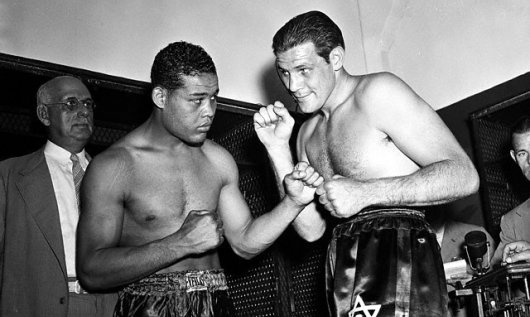
He Beat Giant Buddy Baer Twice

By Bobby Franklin

Poking around on social media recently I came across a discussion where the “experts” were once again going on about how today’s big heavyweights would be just too strong for the champs from previous eras. There was little disagreement that guys like Wilder, Joshua, and the Klitschko brothers would walk through fighters such as Joe Louis, Rocky Marciano, and Jack Dempsey. One person commented that all of the big heavyweights of the past 25 years would have beaten all of the smaller heavyweights that came before them. These people seem to believe we were living in Munchkin Land until the past couple of decades. Using their reasoning we would have to believe Jess Willard and Primo Carnera were the greatest heavyweight champions of the past century since they were comparable in size to today’s fighters. 

I could go on about the number of “small” heavyweight champs who took apart men much larger in size than they were. I have written in the past that in many of these matchups where the champ was taking on a much larger opponent, not only did the smaller man win, but it was not even close to being his toughest fight.

Since it seems so many of these experts just can’t get past believing size is the most important factor in deciding the outcome of a heavyweight fight I thought I would once again come up with an example of why someone like Joe Louis would have had no problem defeating today’s crop oversized champs.

Buddy Baer was a contender for the heavyweight title in the early 1940s. He was the brother of former champ Max Baer. At 6’ 7” and weighing in at around 250 pounds he was comparable in size to today’s heavyweights. Buddy was also a tremendous puncher scoring 49 knockouts in his 53 wins. He lost only 7 fights and was stopped just twice. Baer was also lean and agile. He had excellent boxing moves to go along with his great strength. Unlike today’s wild swinging heavyweights, Baer threw short, accurate punches.

In 1941, Buddy stopped Tony Galento a win that put him in position to challenge heavyweight champ Joe Louis. The fight was set for May 23, 1941 in Washington, DC. Louis weighed in at 201 3/4 to Baer’s 237 pounds. Buddy, at 6’7”, was also 5 inches taller and had a much longer reach. Seeing the two of them step into the ring together gives you a sense of what Louis would have looked like matched up against Klitschko or Wilder. The one difference being that Buddy Baer was a much better boxer that either Deonty or Vlad.

Boxing experts covering the bout in 1941 were bit more savvy than those around today. They made Joe Louis a ten to one favorite over Baer despite the difference in weight and height. The experts I hear from today would have had Baer a hundred to one favorite based on his size. After all, how could Louis possibly beat someone so much bigger than he was? We all know Wilder and Klitschko would just walk through Louis because of their size and strength. The same would have to hold true for Baer. 

A funny thing happened when the bell rang for the start of the fight. Baer came out aggressively and went after Louis. Baer was not prone to the wild swings such are used by Deonty Wilder. Instead, he used much shorter and well placed punches. He did back Louis up. He even managed to deck Joe with a short and accurate left hook, sending Joe through the ropes. But after that  the fight became pretty much a one sided affair. You see, Louis did something that today’s experts aren’t terribly familiar with; He used his great boxing skills to turn Baer’s size against him. Joe was able to slip inside the big man’s arms and hit him with short and powerful punches that hurt him. 

Buddy Baer was no quitter and did manage to stay in the fight trying his best to overpower Louis, but by the sixth round he was nearing the end. In that round Louis floored Baer three times with devastating and accurate blows. The final knock down finished him off. There was some controversy over the ending of the fight as Baer’s handlers argued the last knock down had come from a punch that was landed after the bell. Baer was protecting himself at the time it was landed, so if the bell had indeed rung before the punch had landed neither fighter heard it. It made no difference in the outcome of the fight.

It did make a difference in how the fight was ruled. Baer was helped back to his corner and was on his stool when the bell rang for the seventh round. His handlers argued he should be given the win because of a foul. Referee Arthur Donovan did not agree and instead disqualified Baer because his seconds would not leave the ring and allow the fight to continue.

Louis v Baer Second Fight

The minor controversy was enough to get Buddy a rematch with Louis, and on January 9, 1942 the two met again at Madison Square Garden. This time Baer came in even heavier for the fight probably figuring the extra weight would work to his advantage. That theory feel apart before the bell could ring ending the first round. Louis was devastating in taking the giant apart dropping him three times in less than three minutes with the final knockdown being for the ten count.

If you can’t seem to visualize Joe Louis handling himself against the overgrown champs of today just take a look at his matches with Buddy Baer. You will see how the old adage “The bigger they are, the harder they fall” applies. 

Joe Louis would have no problem dealing with today’s unschooled giants. They would provide target practice for him. To say a Deonty Wilkder would be too big and strong for Louis is simply laughable. Joe would have had a field day with him.

It should also be noted that when Louis and Baer fought the second time WW II was underway. To help with the war effort Louis donated his entire purse of $47,100.94 from the fight to the Navy Relief Fund. Not only was Joe Louis a great champion, he was also a great American.  

“Oklahoma!” Opening At The Ogunquit Playhouse

Rodgers and Hammerstein’s Oklahoma! Bursts Onto the Ogunquit Playhouse Stage Just in Time to Celebrate its 75th Anniversary! 

Rodgers and Hammerstein’s great American classic Oklahoma! bursts onto the Ogunquit Playhouse stage June 13 to July 7. The Playhouse is thrilled to create an exciting new production of this beloved classic as part of its 75th Anniversary since first opening on Broadway. This groundbreaking musical was Rodgers and Hammerstein’s first collaboration, and in many ways their most innovative, having set standards for musical theatre that are still being followed today. The lively musical features the timeless classics, “Oh, What a Beautiful Mornin’,” “The Surrey with the Fringe On Top,” “I Cain’t Say No,” “People Will Say We’re in Love” and of course the triumphant “Oklahoma!”

“Now, with Oklahoma! celebrating its 75th Anniversary, it seemed the perfect time to bring this beloved classic to our stage. The Ogunquit Playhouse production will feature the original designs from Cameron Mackintosh’s London and Broadway revival of Oklahoma!, and Susan Stroman’s choreography, which will be tailored for our production by Susan Stroman’s Associate Ginger Thatcher. Our show will be helmed by Fred Hanson, who together with an outstanding cast will create a fresh, lively and exuberant Oklahoma!,” stated Executive Artistic Director Bradford Kenney.

The high-spirited rivalry between the local farmers and cowboys living in Western Indian Territory at the turn of the twentieth century, provide the colorful setting for Curly, the confident cowboy, (Stephen Mark Lukas) and Laurey, the beautiful, head-strong farm girl, (Taylor Quick) to play out their love story. Throw in a fierce rival vying for Laurey’s attention, one flirtatious fiancée, a reluctant suitor, magnificent choreography and one of the most beautiful musical scores ever written and you have a recipe for a rip-roaring good time! 

Individual tickets are on sale now with prices starting at $52. Three and four-show packages are also available for the current season. Gift certificates are also on sale. For tickets visit www.ogunquitplayhouse.org, the Box Offices located at 102 and 10 Main Street, Ogunquit or call 207-646-5511.

Attention Was Not Paid: “Fall”

 Fall

By Bernard Weinraub

Directed by Peter DuBois

Through June 16

The Huntington Theatre Company

Calderwood Pavillon, Boston 

Reviewed by Bobby Franklin

(Note: This play had an emotional impact on me, and because of that I have decided to focus more on the story than in writing an in-depth review of the production.)

Watching a recent performance of Bernard Weinraub’s Fall at the Calderwood Pavillon was an emotional experience. The play about Arthur Miller, his wife Inge Morath, and their son Daniel who was born with Down Syndrome is not a happy story. It certainly stirred up a lot of anger in me. Before I get into the story I want to say a few words about the production so as not to confuse my feelings about the play with the my opinion of how fine a production this was.

Nolan James Tierce and Josh Stamberg
(Photo Credit: T. Charles Erickson)

The cast is led by Josh Stamberg as the great playwright Arthur Miller, with Joanne Kelly as his third and last wife. John Hickok plays theatrical producer Robert Whitehead,  Joanna Glushak as Dr. Wise. Nolan James Tierce, an actor with Down Syndrome, takes on the role of Daniel, and while Mr. Tierce does not have a lot of lines, I found his words to be the most moving of any uttered by the rest of the cast. 

This was a superb production from top to bottom with each cast member giving strong performances, a tight script, incredible sets and lighting, along with the usual excellent direction of Peter DuBois. 

The difficulty I had with it had nothing to do with the production, it had to do with the subject matter, and Arthur Miller in particular. I know author Bernard Weinraub did not want to portray him as a villain, but after watching Josh Stamberg’s solid performance as Mller I felt nothing but disgust for that self-centered hypocrite. Joanne Kelly’s Inge comes across a bit more sympathetically, but in the end I even felt the pangs of loathing for her.

Josh Stamberg, Joanne Kelly, and Joanna Glushak
(Photo Credit: T. Charles Erickson)

Early in the play we witness Miller and Morath after she has given birth to their son Daniel. They are in the hospital and are given the news that there is a problem with their son. When they are told he has been born with Down Syndrome they are devastated, as just about any parents would be. They have to make some decisions about how to care for Daniel. It is 1966 and at that time doctors were advising parents that the best course was to have “these children” institutionalized as that would ensure they would get the best care. Inge wants to keep her son, Arthur can barely look at him. The decision is made to send him to an institution. It is all quite heartbreaking.

For the almost two hours that follow we witness the story of how Arthur and Inge went on with their lives. Of how Miller refused to even see his son, or as it is said “deleted” him from his life. The great moralizer continued to speak out about social justice causes, preaching on how we should treat each other all the while neglecting his own son. He continued living life fully in the public eye while keeping Daniel hidden away.

We hear of how his creative abilities diminished after Daniel was born. I am not sure if that is supposed to elicit some sympathy for the man, but I could not muster any. Now, I am fully aware that at the time of Daniel’s birth things were different. Many parents were only trying to do the right things when following the advice of the doctors who recommended institutionalization. However, in Miller’s case it is clear he wanted Daniel “erased” from his life. He saw this as “a life sentence”. Why? Was it shame? Was it fear he would not be able to be a good father to his son? Or was it merely that Daniel was going to be an imposition on his and Inge’s lives? Whatever it was, I saw no sign that he felt any love at all for Daniel. It was that coldness that struck me deeply and made me unable to find any sympathy for the man. In fact, by the time the play was concluded I was filled with disgust for him. 

Fall gives us much to think about. It is easy to say “it was different then,” that today we understand people better and are more compassionate, but is that really true? Today, more likely than not Arthur and Inge would have known about Daniel’s condition before he was born. They most likely would have “deleted” him before he came into the world. Miller would have been able to continue moralizing with a clear conscience. The latest figures I could find say 67% to 90% of unborn babies diagnosed with Down Syndrome are not brought to term. It has to be a heart wrenching decision for parents to make, and I can’t imagine being in that postion. I doubt very much that the parents who make such a decision feel they are erasing a child from their lives. They must suffer greatly. I doubt very much Miller would have agonized for even a moment over the decision, and that is what I found so disturbing. It is and should be, a very difficult and heart breaking decision. 

We find out at the end of the play that Daniel is still alive, and he has lived a very happy and fulfilling life eventually living with a foster family who loved him. He did go to meet his father once but was not greeted warmly. Daniel’s words spoken by Nolan James Tierce at the end of the play show what a truly remarkable man Daniel has become. How he came to know the true meaning of family. And, how lucky the world is that he was not deleted. 

On a personal note. I grew up in a neighborhood where there were a number of children with Down Syndrome. This was not long before Daniel was born. I never heard about having such children sent off to institutions. They were part of our community and were well loved. Maybe, people in my area could not afford to send their children away. I believe they kept them because they could not imagine life without them. With the advances in science that now allows us to know before birth if a child will be born with Down Syndrome I can’t help but wonder if we really have changed all that much. Some questions haunt me. Is a child with Down Syndrome less worthy of being brought into the world? If so, what does that say about the children who are living? Are they less worthy than others? These are hard questions.

Nolan James Tierce
(Photo Credit: T. Charles Erickson)

As I was leaving the theater I was thinking how nice it would have been to see the story told from Daniel’s side. This was still all about Arthur Miller and his egotism. Attention must be paid, and it should be paid: to Daniel. When you see Fall listen closely to the words spoken from the heart by Nolan James Tierce at the end. Pay close attention to those words as they are so much more important than trying to figure out why Arthur Miller behaved so terribly.

Seaglass Performing Arts Announces Spring Concert

Seaglass Performing Arts 

Presents

Happy Birthday Lenny!

Seaglass Chorale, under the direction of Jean Strazdes, Artistic Director, will present a tribute to Leonard Bernstein in celebration of what would have been his 100th birthday (1918- 2018). Performances will include selections from West Side Story, Wonderful Town, Candide and others. 

Concerts will take place on Saturday, June 2nd, at 7:00 pm at Christ Church in Kennebunk and Sunday, June 3rd, at 3:00 pm at Wells High School in Wells. 

Tickets are available through Seaglass [at] gwi [dot] net; via phone at 207.985.8747; and at Morse Hardware on Post Road in Wells. Tickets are also available at the door. Prices: $15/adult; $12/senior and student 

Smokey Joe’s Cafe At The Ogunquit Playhouse Treats You Nice


Smokey Joe’s Cafe: The Music of Leiber and Stoller

Through June 9 at The Ogunquit Playhouse

Reviewed by Bobby Franklin

Kyle Taylor Parker, Dwayne Cooper, John Edwards, and Jelani Remy
(Photo by Gary Ng)

Smokey Joe’s Cafe: The Music of Leiber and Stoller now playing at the Ogunquit Playhouse is 90 minutes of non-stop entertainment. This high energy musical revue showcasing the classic rock and roll hits of Jerry Leiber and Mike Stoller has a cast of ten backed up by a six person orchestra. The musicians are onstage, and sometimes take center stage, throughout the performance. 

Most people are familiar with the Leiber and Stoller songbook. 38 of the songs are performed on the Playhouse stage, including a few of the lesser known works, which is an added treat as they should be better known. 

If you are looking for the story behind the songs you won’t find it here. What you will find is a cast that works non stop from start to finish while all the time appearing to be having as good a time on stage as the audience is having while watching them. From the opening number to the final encore there is never a dull moment. The cast has the Ogunquit Playhouse really rocking. 

The outstanding set is two levels with winding iron stairways on both sides. It has a bar and the walls are mostly red brick. There is much neon lighting. Those neon lights are put to good use during the number On Broadway. The tables and chairs are also used in many of the numbers. Scenic designer Beowulf Boritt has done a marvelous job. 

Dionne D. Figgins and Dwayne Cooper
(Photo by Joan Marcus)

At no time during the performance did I feel like I was simply watching a bunch of musicians belting out one song after another. Thanks to the brilliant choreography of Josh Bergasse who is also the director, each number was something unique and special. Running through just a few of them, there was Jelani Remy’s Jailhouse Rock with some acrobatic dancing that would have impressed Elvis. 

Remy, along with John Edwards, Dwayne Cooper, and Kyle Taylor Parker captured the original Coasters sound on Searchin’, Young Blood, Charlie Brown, and a truly inspired and crowd pleasingly funny version of Along Came Jones. John Edwards brought the house down with his portrayal of Poor Sweet Sue who keeps falling into the clutches of Salty Sam. 

Nicole Vanessa Ortiz and Alysha Umphress, along with Max Sangerman on guitar gave a solid performance on Kansas City. Ms Ortiz’s version of Hound Dog reached back to the wonderful original version by Big Mama Thornton while Dionne Figgins and Jelani Remy gave a sensual Spanish Harlem with Ms Figgins moving beautifully around the stage while being serenaded by Mr. Jelani. The touch of Spanish guitar was perfect for it.

Emma Degerstedt withJelani Remy, Shavey Brown, Dwayne Cooper, and Max Sangerman
(Photo by Joan Marcus)

Emma Degerstedt on Teach Me How To Shimmy is attired in a hot pink shimmy dress that in and of itself deserves to be listed as a member of the cast. Alysha Umpress captures the melancholy mood on Pearl’s A Singer. 

Max Sangerman and the rest of the male members of the cast harmonize beautifully on an a cappella version of Loving You. Alysha Umpress performs Trouble while accompanied by Yuka Tadano, giving it a jazz flavor.

For Dueling Pianos most of the orchestra was rolled out on center stage with two upright pianos back to back. With Sonny Perkins and Matt Oestreicher facing off on the keyboards it was like having Jerry Lee Lewis in stereo. This was a rip roaring number. 

I have only touched on a few of the many great songs performed in this revue. There is much, much more. 


Jelani Remy, Shavey Brown, John Edwards, Dwayne Cooper, and Max Sangerman
(Photo by Joan Marcus)

Smokey Joe’s Cafe is really enhanced by the choreography. All of the movements on stage go perfectly with this great music. The energy pumping out on stage is impossible to resist. At times the cast members dance up and down the aisles while the entire theatre is rocking. It is something to experience. 

On the evening I was there Mike Stoller was also in the audience. After the encore he took to the stage to say a few words. It was very touching as he spoke of his late partner Jerry Leiber. He told of how he would call him whenever he had news, and took this occasion to relate what he would have said to him after watching these young performers do such a fine job with the music he and Mr. Leiber created. He was deeply touched by it all. 

This production of Smokey Joe’s Cafe; cast, sets, and costumes, along with director Josh Bergasse will be transferring to New York in July. I highly recommend seeing it now before it moves on. It’s been a long winter and I can think of no better way to get ready to welcome the summer than by taking a ride to beautiful Ogunquit, Maine and getting your rock and roll juices flowing with this knock out of a show. 

Smokey Joe’s Cafe: The Music of Leiber and Stoller

Playing through June 9

The Ogunquit Playhouse

Rt. 1 Ogunquit, Maine

207.646.5511

ogunquitplayhouse.org 

Mickey Walker

The Toy Bulldog Took

On Heavyweights

Fought Greb In And Out Of The Ring

By Bobby Franklin

When trying to rank the greatest fighters of all time there are many different criteria used. Included in these are boxing ability, punching power, defensive skills, longevity, consistency, the ability to take a punch, and the opposition encountered.

Mickey Walker

Former Welterweight and Middleweight Champion Mickey Walker  would not rank high in the categories of boxing boxing ability and defensives skills, but he more than made up for that in the ability to take a punch, longevity, and the quality of the opponents he took on. Not only did he win the welterweight and middleweight titles, he also fought for the light heavyweight championship losing a decision to Tommy Loughran. But that was not enough for the 5’7” slugger. He also became a contender for the heavyweight championship. 

Walker, from Elizabeth, New Jersey, began his professional career in 1919, and in 1921 he held welterweight champion Jack Britton to a draw over 12 rounds. In 1922 he would get another shot at Britton and this time he pulled out a decisive win knocking the champion down 4 times on his way to winning the title.

In 1925, Walker moved up in weight class and took on middleweight champ Harry Greb in a bout that would become the stuff of legend. Well, not the bout in the ring but the one that supposedly took place in the hours after that encounter.

Walker and Greb Before The Bell

In a 1981 interview with Peter Heller for his book “In This Corner”, Walker told his side of the story. He concedes Greb won the fight in the ring that night but says he won the rematch that took place outside of a barroom hours later. About Greb, Walker had this to say “He gave me a good shellacking the night we fought. The fight after, on the street, I always take credit for winning that, so I was champion anyhow.” He goes on to relate how the two had been drinking together in the company of their girlfriends. The trouble began when they walked outside and Mickey told Greb “You know Harry, you’d never have licked me if you didn’t stick your thumb in my eye.” Walker said he didn’t mean it as an insult, but Greb certainly took it as one. Harry responded “Why you bum, I could lick you if I had no hands, and I’ll show you.” As Greb said this he began taking off his jacket. Just as Harry had his coat part way off and with the sleeves down by his elbows Walker fired off his best shot at him. According to Mickey, Greb flew four feet into the air and up against a wall before crashing to the ground. At this point a huge policeman stepped in and broke things up. 

After his evening with Greb, Mickey returned to defending the welterweight title but in 1926 he lost it to Pete Latzo. At this point he was having difficulty making the weight. He returned to the middleweight division and later that same year he won the title from Tiger Flowers. 

It was at this point that Walker got an itch to go after bigger game. Though he had not gotten any bigger he decided to campaign in the light heavyweight division and took on former champ Mike McTigue whom he kayoed in one round. He then won a decision over Paul Berlanbach. Mickey continued defending his middleweight crown while fighting the bigger men and eventually earned a shot at the light heavyweight championship taking on champion Tommy Loughran. On March 28, 1929 he lost a ten round split decision to the smooth boxing Loughran.  

After the loss to Loughran, Walker ran off 22 straight victories in the middleweight and light heavyweight divisions. He also did something else; he began fighting heavyweights. He believed he would have better luck against the very big guys because they would be slower and easier to hit. For a time it looked like his reasoning was paying off. He beat the very tough Johnny Risko twice and then took on the fearsome Bearcat Wright. Outweighed by 42 pounds and a half a foot shorter than his opponent, Walker, after being down briefly in the first round, came back to floor Wright and by the tenth and final round had Bearcat hanging on. Mickey won the decision and the opportunity to take on Jack Sharkey in an elimination bout to determine a challenger to champion Max Schmeling.

Walker vs Sharkey

Walker fought aggressively against Sharkey and, while absorbing quite a few heavy blows fromJack, kept the pressure on to earn a draw with the future heavyweight champion. It was an amazing performance by the 5’7″ Toy Bulldog.

Mickey continued taking on heavyweights and defeated King Levinsky and Paulino Uzcudun while dropping a decision to Johnny Risko in their third meeting. In 1932 he would be matched with the now former champion Max Schmeling. A win over Schmeling would put Walker in line for a shot at champion Jack Sharkey. 

Walker vs Schmeling

Schmeling was the one big man Walker should not have stepped in with. Mickey’s straight at you style was made to order for the counterpunching German who knocked Walker down late in the first round. Mickey took an awful beating as Max continually landed with his vaunted right hand. Mickey kept attempting to land hooks on Max but was out punched time and again In the 8th round Walker, with his eyes swelling shut was dropped two more times. At one point Schmeling pleaded with the referee to stop the fight. When Walker returned to his corner his seconds waved the towel signifying their man had had enough. 

In the Schmeling fight Mickey showed incredible courage, but this fight also took a lot out of him. He would continue fighting but was never the same again. He would challenge one more time for the light heavyweight title, losing a decision to Maxie Rosenbloom. He never lost his middleweight title, rather he gave it up when he set his sights on the heavyweight throne. 

Schmeling Pleads With The Referee To Stop The Bout

Mickey Walker retired from the ring in 1935. His final record is believed to be 131 wins (60 by knock out), 25 losses, 2 draws, and 2 no contests. After retiring he opened a restaurant in New York City and also took up painting. He earned some renown as an artist and his work was displayed in galleries in New York and London.

Walker died in 1981 after suffering from Parkinson’s Syndrome no doubt brought on from his years in the ring. If greatness was judged solely on toughness and heart Mickey Walker would rank very near the top.

Reagle Music Theatre of Greater Boston Opens 50th Anniversary Season With: A Chorus Line

Directed by Broadway’s Leslie Woodies

Starring Boston’s own Scott Wahle as “Zach” and Kirsten McKinney as “Cassie”

Reagle Music Theatre kicks off the company’s spectacular 50th Anniversary Summer Season with A Chorus Line from June 7-17.  The multiple Tony Award-winning musical will run for 8 performances at the Robinson Theatre, 617 Lexington St., Waltham, MA.  A Chorus Line is the ultimate Broadway story, following the hopes and dreams of young performers as they bare their souls auditioning for a Broadway musical.  A Chorus Line will feature a roster of regional talent featuring newsman and IRNE award winning actor of stage and screen, Scott Wahle as “Zach”, and IRNE award and Tommy Tune Award winner Kirsten McKinney as “Cassie”. 

The production is backed by a full, live orchestra and includes the original Broadway costumes!  Produced by Robert J. Eagle; Directed and Choreographed by Leslie Woodies (A Chorus Line, On Your Toes); Music Direction by Dan Rodriguez (In the Heights, Show Boat).

A Chorus Line is a stunning celebration of the unsung heroes of the American Musical Theater – the dancers and singers of the Broadway chorus.  A Chorus Line takes the audience through the final grueling audition for a new Broadway musical while exploring the inner lives and poignant ambitions of the Broadway hopefuls competing for a spot on the stage. The show features one powerhouse number after another including “What I Did for Love,” “One,” “I Can Do That,” “At the Ballet,” “The Music and the Mirror,” and “I Hope I Get It.”  A fusion of song, dance, and drama, A Chorus Line was instantly recognized as a classic winning nine Tony Awards in addition to the 1976 Pulitzer Prize for Drama. The original Broadway production ran for 6,137 performances.

Reagle Music Theatre’s 50th Anniversary production of A Chorus Line features a full cast of 27 performers from Boston, New York and across the country, starring Boston’s own Scott Wahle as Zach and Kirsten McKinney as Cassie Ferguson.

Performance Schedule:  Thurs, June 7th at 3:00 PM; Fri, June 8th at 7:30 PM; Sat, June 9th at 7:30 PM; Sun, June 10th at 2:00 PM; Thurs, June 14th at 3:00 PM; Fri, June 15th at 7:30; Sat, June 16th at 7:30; Sun, June 17th at 2:00 PM.

To purchase, visit www.reaglemusictheatre.org, call 781-891-5600, or visit the theater box office at 617 Lexington St, Waltham, MA, 02452. Hours of operation are Monday through Friday from 9 a.m. to 4:30 p.m., Saturdays 10:00 a.m.-2:00 p.m., with extended hours from 9:00 am to curtain on performance days.

The Huntington Theatre Presents the World Premiere of “Fall” 

The True Story of Arthur Miller’s Secret Son

May 18-June 16, 2018 at Huntington’s South End/Calderwood Pavilion at the BCA


The Huntington Theatre Company presents the World Premiere of Fall, which tells the true story of Pulitzer Prize-winning playwright Arthur Miller’s secret son Daniel, his child with third wife, Inge Morath. Born with Down syndrome, Daniel was institutionalized, and his existence was never acknowledged by his parents. Written by playwright and renowned journalist Bernard Weinraub (The Accomplices, Above the Fold), and directed by Huntington Artistic Director Peter DuBois, Fall runs May 18 – June 16, 2018 at the Huntington’s Stanford Calderwood Pavilion at the Boston Center for the Arts.

The cast includes Josh Stamberg (Showtime’s “The Affair,” NBC’s “Parenthood,” and The Power of Duff and Female of the Species at Geffen Playhouse) as Arthur Miller. Joanne Kelly (The House of Yes at the Storefront Theatre, Proof at Red One Theatre Collective) plays Inge Morath, a photographer and Miller’s third wife. Joanna Glushak (Sullivan and Gilbert and The American Clock at the Huntington, War Paint on Broadway) plays Dr. Wise. Nolan James Tierce (Harvey at Newton Country Players), a local actor with Down syndrome, plays Daniel. John Hickok (Parade, Little Women, and Aida on Broadway) plays Broadway producer Robert Whitehead.

Arthur Miller was perhaps the most celebrated American playwright of the 20th century, with masterful plays, Death of a Salesman, All My Sons, A View from the Bridge, and The Crucible, capturing the darker side of the American Dream, the political zeitgeist of the day and, somewhat ironically, the bonds of the American family — particularly fathers and sons. His life and career was threaded through the culture of the country in the mid-20th century: he divorced his first wife to marry Marilyn Monroe; he was subpoenaed by the House Un-American Activities Committee; he won the Pulitzer Prize and numerous Tony Awards; and he spoke out against the Vietnam War. Miller was seen by many as a moral conscience for the nation.

But despite chronicling the “common man” and the American Family, Miller did not acknowledge his own son. Daniel was not mentioned in Miller’s autobiography, Timebends, or in either of his parents’ obituaries in The New York Times. Playwright and former Times reporter, Bernard Weinraub became engrossed with the Millers’ story after reading a Vanity Fair article about them in 2007. He took a journalist’s approach to translating the story for the stage, interviewing social workers and others who knew and worked with the family. Fall explores the fascinating dichotomy of Miller’s life with Morath (the couple also had a daughter, Rebecca) and the divide between their public personae and their private lives.

“Arthur Miller was one of our greatest playwrights. His best dramas dealt with fathers and sons, guilt and betrayal, and essentially, our responsibility towards each other,” says Weinraub. “He dealt with the paradoxes and tensions of our lives. What interested me here was the contradiction between the man and the artist. And the impact of his actions on his art.”

“Miller wrote many plays about the sins of a father being visited on a son, and as a writer he provided a moral compass for a generation,” says DuBois. “Bernie’s exploration of this iconic man is a story that remained with me since the first time I read the script a few years ago. I’m proud Boston audiences will be the first to see this show and discover more about a playwright they thought they knew.”


 huntingtontheatre.org       Box Office: 617.266.0800