Category Archives: Boxing Articles

Remembering Carlos Ortiz

Carlos Ortiz

One Of The Last Of The

Golden Age Champions 

Answers His Final Bell

By Bobby Franklin

Carlos Ortiz

Carlos Ortiz passed away on June 13th at the age of 85. Born in 1936 in Ponce, Puerto Rico, Carlos began fighting professionally at the age of 18. Well schooled, he was a superb boxer/puncher who certainly rates up there with the best lightweights of all-time.

Ortiz turned pro in 1955 and Ortiz had a record of 28 wins suffering just one defeat over the first three years. That loss was to Johnny Busso in1958. He beat Busso in a rematch three months later. In 1959 he got a shot at the vacant Light Welterweight Title. In a bout against Kenny Lane Carlos won recognition as the new champion. 

He defended the belt winning by a tenth round knockout over Battling Torres in 1960. Next, he took on  the Italian champ Duilio Loi. The fight took place in California. Loi came in to the fight with 102 wins against just 2 losses. In a close fight Ortiz won a majority decision. This was only Carlos’s 35th fight and he was in there with an extraordinary fighter. 

Ortiz was so confident he could improve on his performance that he agreed to a rematch in Italy just three months later. This fight also ended with a majority decision but in Loi’s favor this time. The two met once more  in 1961. Again fighting in Italy with Loi winning a unanimous decision.

Carlos Ortiz Winning The Lightweight Title From Joe Brown

After the second loss to Loi, Carlos began fighting as a lightweight. In 1962 he challenged the great Joe Brown for the title. Ortiz won convincingly and his reign as champion began.

In 1965 he lost the crown to Ismael Laguna but won it back the following year. He would continue as champion until 1968 when he was defeated by Carlos Teo Cruz. Despite having lost by a split decision, Ortiz did not fight for  the championship again. He went into semi-retirement and fought only once over the next three years. That fight being a win against Edmundo Leite in November of 1969.

Carlos Ortiz Defeating Ismael Laguna In 1967

Carlos retired after that fight, but then made a comeback in 1971. As with so many fighters, he had fallen on hard times. Now 35 years old he was long last his prime but still felt he could win back the lightweight crown. 

After winning nine straight fights he was matched against Lightweight Champion Roberto Duran in a non-title fight on the undercard of the second Patterson/Ali fight in New York. Duran came down with the flu and dropped out of the fight a week before it was scheduled to happen. Former Champ Ken Buchanan stepped in to take his place.

Maria And Carlos Ortiz

The match turned out to be one sided. Father time had caught up with the great champion. Ortiz, exhausted, retired after the 6th round. He gave it all he had but just could not turn the clock back. It was the only time he was stopped in 70 fights. When interviewed after the fight a candid Carlos said 

“This was definitely my last fight. I started tiring in the 4th round. And I realized after the 6th that I couldn’t go on and I didn’t want to make a fool of myself. I was in the best shape I could have been. Time just caught up with me.” 

Boxing historian and author of The Arc of Boxing, Mike Silver knew Carlos well. I reached out to him for his thoughts on Ortiz, the man and the boxer. Here’s what he had to say:

Mike Silver remembers Carlos Ortiz: Carlos Ortiz’s storied career represents so much in boxing that has been lost over the past two generations. He was among the last of the great “golden age” champions and contenders who turned professional in the decade after World War II and achieved a level of skill that evoked admiration from the old-time trainers who’d seen every great lightweight champion since the 1920s. He was a consummate boxer and ranks as one of the greatest lightweight champions of the 20th century, up there with Leonard, Canzoneri, Ross, McClarnin, Mandell, Ambers, Williams, Carter and, yes, Roberto Duran. How he would have done against those legends is pure speculation, but they would have been competitive contests. Taking nothing away from Duran, but Ortiz’s competition in the lightweight and junior welterweight divisions had more depth. Duran held victories over Hector Thompson, Ken Buchanan, Esteban DeJesus, the Viruet brothers and Sugar Ray Leonard. Ortiz defeated Len Mathews, Paolo Rossi, Dave Charnley, Kenny Lane, Dulio Loi, Flash Elorde, Sugar Ramos, Ismael Laguna, and drew with Nicolino Loche in Argentina (Loche’s hometown). 

 When I am asked to recommend a fight to watch on YouTube that would demonstrate the art of boxing at its best my answer is the third match between Carlos Ortiz and Ismael Laguna. It is like watching a class in brilliant boxing technique, especially as relates to effective use of the left jab, timing, and counter punching skills. Laguna was a fine boxer with extraordinary speed, but Ortiz was a master technician with all the answers.    

I had the honor of interviewing Carlos Ortiz in 1998. (This interview is included in Mike’s latest book “The Night The Referee Hit Back: Memorable Moments From The World Of Boxing”).  I have met and interviewed dozens of former world champions and top contenders. What impressed me about Ortiz was his intelligence, and I’m not just talking about boxing intelligence. Carlos, I am positive had a very high IQ, and could have succeeded in any profession he chose. But, thankfully for us, he chose boxing (or more correctly boxing chose him) and we fans are all the richer for it.

In his 70 fights Ortiz won 61 times with just 7 losses, 1 draw, and 1 no-decision. He scored 30 kayos.

My condolences to the Ortiz family, and to Carlos’s lovely wife Maria. Carlos Ortiz will be missed but never forgotten.
Did Baer Throw The Braddock Fight? Yes!

Braddock vs Baer

Was It On The Level?

By Bobby Franklin

(This article originally appeared in the Boston Post Gazette in 2019)

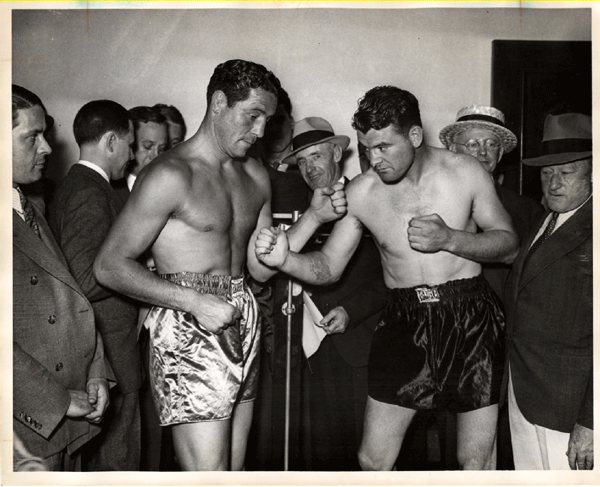
Baer And Braddock At The Weigh In

On June 6, 1934 Max Baer won the Heavyweight Championship of the World by defeating Primo Carnera in the 11th round. He had floored the courageous champion 11 times on his way to winning the crown. Baer, who had preciously scored a brutal kayo over Max Schmeling, looked like a man who would be champion for quite some time. He was a brutal puncher in the ring while possessing the charm of a Hollywood leading man outside of it. in fact, he had made himself a bit of a reputation acting in movies. He was a man sitting on top of the world.

Just a few days over a year later that would all change when Max put the title on the line on against the lightly regarded James J. Braddock. Braddock had been a leading light heavyweight contender a few years earlier, but injuries and a number of loses had derailed his career. He had managed to string together a number of wins over heavyweights and position himself for a shot at Baer. Nobody gave him a chance, and many thought he was risking his life to step in the ring with the murderous punching Max. 

In fact, earlier in his career Baer had killed Frankie Campbell in the ring, and many also believed he was the one responsible for the death of Ernie Schaaf who collapsed and died in his fight with Primo Carnera after being hit with a left jab. In an earlier fight with Baer Schaaf had taken some terrible shots and was knocked unconscious as the final round ended. He was saved by the bell and lost a decision to Baer.  It is believed the blows from Max had caused an injury to Ernie from which he never recovered, resulting in his death in the Carnera fight. 

It seemed unbelievable Braddock would have any chance against Baer. While he was certainly a very capable boxer, he just would not have the strength to hold off the dynamite that was in Max’s two fists. He went into the fight a ten to one underdog. However, he did go on to win the title that night, and along with that win he became known as the Cinderella Man. 

Most people are now familiar with the Braddock story from the 2005 movie directed by Ron Howard. In the movie Braddock’s fight with Baer is depicted as a life and death struggle with Jimmy hanging on to win a close and exciting fight. Actual footage of the fight tells a different story.

When I was a kid my father and I watched an 8mm film of the Braddock/Baer match on a home movie projector. It was the only time I had seen the fight until I viewed it again the other day. I do remember when watching it with my father how surprised he was at what he saw. He was a teenager when the bout took place but had never seen it. He was a great admirer of Braddock, particularly because after winning the title James had repaid the money he had collected while on relief (welfare) when things were bad for him and his family. I admired that about him as well.

They Were Just Dancing

What surprised my father while watching the film was how the two men were fighting. He had always believed Braddock had won in the manner depicted in the Ron Howard movie. After viewing the film for a short while my father exclaimed “Max threw the fight!” He was disappointed to see that, as it took the glow off of Braddock’s win. My father also liked Baer very much so that added to his disappointment. He justified it all by saying Max probably did it because he liked and felt sorry for Braddock and his family. 

I decided to take another look at the fight to see what I would think after all of these years. After viewing highlights from each of the 15 rounds, I have no doubt at all that Baer threw the fight. I even think it is possible Braddock was in on it as well. For most of the fight it looks like two guys trying not to hurt each other. It is nothing like the all out battle seen in the Howard movie. 

Let’s Talk

The fight, which took place on June 13, 1935 at the Madison Square Garden Bowl on Long Island, was one of the most boring in history. With the exception of one round, the 7th, Baer didn’t through any serious punches, and in that round he only opened up because the crowd was booing and he felt he had to look like he wasn’t dogging it. When he did land a decent right hand he hurt Braddock but immediately backed off. 

At the opening bell you would think it was Jimmy who had the tremendous power in his hands as Baer began the fight by backpedaling. As the fight progressed Baer did some clowning that brought laughter from the crowd and which was more exciting than fight itself. He also was talking to Braddock quite a bit, and if you watch closely it appears the two men are speaking to each other in the clinches. It would be interesting to know what they said to one another. 

They seemed to be afraid of hurting one another.

Going into the fifteenth round Braddock appeared ahead in the scoring. Max had to know this, yet he did nothing to try and save the title. In fact, the two men spent most of the round at close quarters exchanging light punches. They seemed to be afraid of hurting one another. The fact that Braddock was also not throwing hard punches gives me reason to believe he was aware of the fix. 

Braddock

In the end James J. Braddock was award the decision. The scoring on one judge’s card and the referee’s was pretty one sided. The other judge had it scored evenly by rounds at 7-7 with 1 even. However, he gave the fight to Braddock based on points which is the rule in New York when a judge’s card comes up even. 

Neither fighter made a particularly good payday out of this fight as it didn’t draw big money. Ironically, both would make the biggest purses of their careers in their next fight against the same opponent. They both took on Joe Louis.

I have not gotten into the reasons Max Baer would have thrown this fight, but after watching it closely I have no doubt that my father was correct when he said “Max threw the fight!
”

George Foreman Not An All Time Great

Weak Opposition And Fatal

Flaw Keeps Him From Elite Status

By Bobby Franklin

George Foreman

Big George Foreman is remembered as a powerful man and a devastating puncher. His brutal destruction of Joe Frazier in 1973 is etched in every fight fan’s memory. It is mainly off of this performance that George made it onto many people’s lists of all time greats. That January night in Jamaica he looked fearsome. In taking Frazier apart so one sidedly, he took on an almost superhuman status. But on closer examination of his record and boxing technique, the all time great designation doesn’t hold up.

Going into the title fight with Frazier, George had an impressive undefeated record of 37 and 0. Only three opponents had gone the distance with him. Yet, even with those impressive numbers, Frazier was made a 3 1/2 to 1 favorite to retain the title. Joe was also undefeated at the time and had defeated Muhammad Ali in the Fight of the Century less than two years earlier.

While Foreman’s record looks good on paper, when taking a closer look at his opposition the numbers give a clearer picture of why he was the underdog. Out of those 37 opponents there were very few that could be considered serious competition. In fact, in his last bout before facing Joe, George fought Terry Sorrell, who at the time had had a total of 19 fights winning only 4. Sorrell would close out his career with a record of 29 fights with only 6 wins (3 by KO), 22 losses (10 by KO), and 1 draw. 

Some might argue this was just a warmup bout for George before stepping in with the Champ. Well, a warmup bout usually involves having a warm body for opposition. I’m not sure it was ever verified Sorrell had a pulse when he stepped into the ring. 

Three fights earlier George had faced the immortal Clarence Boone. Boone had a record of 30 fights, winning only 3 with 26 losses and 2 draws. Of those 26 losses he had been stopped 14 times. I think the promoters used the same undertaker that provided Terry Sorrell for George.

George Foreman’s vs Gregorio Peralta. February 16, 1970.

Go back one more fight and you will see where an opponent was dug up who made Boone and Sorrell look like Louis and Dempsey. On January 29, 1972, George faced the immortal Joe Murphy Gordwin of Houston, Texas. This would be the final fight of Gordwin’s career and he would bring his remarkable record of 1 win, 1 draw, and an astounding 15 losses (13 by KO) into the ring with him that night. George surely had to be terrified; terrified he might kill Joe Murphy. 

Go back a little further in George’s career and you will find such immortals as Vic Scott (1 win 2 losses), Bob Hazelton (3 wins, 6 losses), Leo Peterson (3 wins, 4 losses), and Fred Askew (2 wins, 6 losses, 1 draw).

Of course, when a young fighter is being brought along, it is not unusual for him to be given “opponents” to face. But usually those “opponents” are fighters who, while not posing much of a threat, do have beating hearts and the ability to provide some opposition so the prospect will have a chance to learn his trade and improve.

Looking back at the rest of George’s opposition in those 37 fights, you will not find a lot of strong opposition. While many are better than those I have just mentioned, most aren’t too far ahead of the Boones and Sorrells. 

George did face a few solid “opponents” during those years. Levi Forte (20 wins, 21 losses 12 by KO, and 2 draws) and Roberto Davila (21 wins, 14 losses 3 by KO) both were the type of boxer an up and coming prospect would be expected to face, and both extended George the full ten round limit.

The most notable names on Foreman’s record at the time were Boone Kirkman, Gregorio Peralta (twice), and George Chuvalo. His wins over Kirkman and Chuvalo were impressive, he struggled with Peralta.

Kirkman was another up and comer who had faced a series of “opponents” and had not been tested. George simply overpowered him.

Chuvalo was known as incredibly tough. He had never been knocked off his feet, and a number of years earlier had given Muhammad Ali a tough go of it. But with the exception of a very odd win over Jerry Quarry, the Canadian never beat a top rated contender. His slow moving style made him an easy target for Foreman’s heavy but wide swings. Big George did look impressive in stopping Chuvalo.

I have written about Foreman’s fights with Peralta. George won their first fight by decision, and stopped Peralta in their rematch. In both fights, George’s flaws were exposed. It was these flaws Ali exploited a few years later to regain the crown.

Looking at the accumulated record of Foreman’s opposition at the time of the Frazier fight you see that combined they had a total of 289 wins, 376 losses, and 58 draws. if you remove the three fighters who had a pulse from that group, Peralta, Chuvalo, and Kirkman you end up with a group that had a total of only 100 wins with 355 losses, and 48 draws. 

Foreman Staggered By Jimmy Young

After defeating Frazier, Foreman defended the title twice in impressive fashion knocking out Joe Roman in one round and Ken Norton in two. Roman would have been considered an opponent if he had fought Foreman earlier, and was far from having an impressive record. Norton was never able to stand up to a big puncher as was seen when he went on to be kayoed in one round by both Earnie Shavers and Gerry Cooney.

After those two defenses George lost the title to Ali who used many of the tactics the over the hill Peralta had employed a few years earlier. After the loss to Ali, George still did not score any major wins with the exception of his victory in a slugfest with Ron Lyle, which was a battle of attrition, not skill.

He closed out his career with a loss to the light punching Jimmy Young, who also used technique to neutralize George’s power. Without that power Foreman had no boxing skill to fall back on to win a fight.

Foreman’s Flaw On Display

His major flaw was extending his arms when trying to parry punches. If you watch him in action, it appears he is trying to emulate Jack Johnson’s strategy of catching punches with an open glove. Only with Johnson, he would grab the punch just before it was about to land on him. With George, he would reach out and try to stop it just as it was being thrown. As a fight moved along he would begin pawing with both his hands and leave himself open. Ali, Young, Peralta, and Lyle were all able to land on him because of this fatal flaw. Any one off the great, and even not so great heavyweights of the past would have spotted this flaw and taken advantage of it. 

George certainly had amazing raw power, but that only takes a fighter so far. He did not develop the skills to make him a great fighter. Sure, he would always have a puncher’s chance against anyone. But hoping for a lucky punch is not the stuff of greatness. George simply never showed the skills to be considered an all-time great heavyweight champion.

I have not discussed Foreman’s second career because it really is not relevant to this discussion. Foreman 1.0 was the prime George and the one to look at when judging him as an all time great.  

A Greek Tragedy—Boxing Style

Book Review: “The Duke: The Life and Lies of Tommy Morrison by Carlos Acevedo”

Hamilcar Publications, 208 Pages, $18.99

Reviewed by Mike Silver

In 1989 a handsome and charismatic twenty year old undefeated professional boxer named Tommy “The Duke” Morrison was on a fast track to super stardom. But all was not as it seemed. “With his bleached pretty-boy look, his genuine charm, and his heartland roots” writes

Acevedo,  “Morrison was billed as a wholesome All-American type, despite an unsavory background that included any number of misdeeds, if not misdemeanors…Like Tyson, Morrison could not restrain his tumultuous nature—not for long, anyway.”

Tommy’s early career had all the earmarks of a “Tysonesque” buildup. That was no coincidence since his manager at the time was Bill Cayton, the entrepreneur who was also Mike Tyson’s first manager. In his first year as a pro Morrison was matched with one tomato can after another resulting in 20 straight wins, including 17 by knockout (15 in two rounds or less). The build-up was intended to impress the masses and get him lucrative television bouts and eventually a shot at the heavyweight championship. 

Despite the pushover competition, it was obvious that Morrison had a ton of natural talent and potential. As an amateur he was rated among the USA’s best heavyweights. He possessed good instincts, fast hands, and technical skills superior to most heavyweights. But what really set him apart was his explosive left hook. In addition, his PR team told the press that Tommy was a great nephew of the legendary movie star John Wayne (real name Marion Morrison aka “The Duke”). Whether true of not, the claim—never verified—added to his mystique. 

One year after turning pro Morrison’s knockout binge and photogenic visage caught the eye of Sylvester Stallone who decided to give the young fighter a co-starring role in Rock V. The notoriety vaulted him into the public consciousness but it was the beginning of the end for Tommy, although no one at the time could predict just how bad the train wreck was going to be.  

Aside from his usual recreational drug use, there is evidence that Morrison had begun taking steroids.

It was not just the Hollywood parties and endless parade of young women who found the attractive—and willing—movie star/athlete irresistible.  Aside from his usual recreational drug use, there is evidence that Morrison had begun taking steroids. The drug, popular with body builders and macho actors, was used by Morrison to maintain enough bulk to cope with oversized heavyweights.  Six months later he resumed his boxing career. His body now appeared more muscular and defined and fifteen pounds heavier. Thereafter he never weighed less than 220 pounds for a fight. 

Steroid use by an athlete has both physical and mental side effects. Unstable behavior, including lack of impulse control and poor judgement has been documented. If someone already has these tendencies they can be exacerbated. Injecting steroids can also negatively affect stamina over the long haul because the increase in muscle mass requires more oxygen to counter fatigue. This could have been the case in Morrison’s disastrous fight with former Olympic heavyweight champion Ray Mercer on October 18, 1991. At the time Morrison was undefeated in 27 fights with 23 wins coming by KO. He was the favorite to defeat Mercer (17-0). 

The referee, who seemed to be half asleep, stood by impassively while Mercer connected with nine punches, with the last three rendering Morrison unconscious. Only the ropes kept Morrison from falling.

Morrison dominated the first four rounds, outpunching and out boxing Mercer. But in the fifth round he suddenly seemed tired. In the midst of an exchange Mercer caught Morrison with a series of punches that drove him into the ropes. What happened next was one of the most disturbing endings to a bout ever seen. The referee, who seemed to be half asleep, stood by impassively while Mercer connected with nine punches, with the last three rendering Morrison unconscious. Only the ropes kept Morrison from falling. While still unconscious he was hit with six additional full power shots before the referee finally pulled Mercer off. It was a devastating defeat. 

Tommy Morrison

Tommy began his comeback 4 months later and over the next year knocked off eight opponents. The winning streak led to a match with former heavyweight champion George Foreman. In the best shape of his life, Tommy avoided going for the knockout, and instead used his superior speed and a jab and move strategy to win a unanimous 12 round decision. It was an impressive victory but just two fights later disaster struck once again when underdog Michael Bentt stopped Tommy in the first round after dropping him three times. Bentt was supposed to be a safe tune-up for an upcoming bout with heavyweight champion Lennox Lewis. The Lewis bout was cancelled. Not only did Tommy lose out on a 7.5 million payday, he also lost his manager who walked away from Tommy after the loss. 

It was at this point that Morrison’s private life began to spin out of control. Convicted of drunk driving and drug possession (it was not the first time) he served 14 months in prison. Resuming his career Morrison took on an assortment of professional losers whose sole purpose was to fatten the records of prospects and contenders.  Acevedo: “Now more than ever, it seems, Morrison and the boxing underbelly are intertwined like characters in the final, bleak pages of McTeague, handcuffed to each other  (one of them a corpse) in Death Valley, California, waiting for the blistering sun to render its impersonal judgement.” 

Boxing’s lack of uniform standards, even at the height of the AIDS epidemic, did not require blood tests.

If being an ex-con, a drug addict, a bigamist (yes, he was married to two woman at the same time), and an alcoholic wasn’t bad enough, in 1996 the Nevada Boxing Commission lifted Morrison’s license when a blood test revealed he had the HIV virus. The commission refused to give out details, but shortly thereafter Morrison held a news conference and revealed he had contracted HIV because of a “permissive, fast and reckless lifestyle.” One person who knew Morrison said he actually had gotten AIDS in 1989 but had remained silent in order to continue fighting. Boxing’s lack of uniform standards, even at the height of the AIDS epidemic, did not require blood tests. (Eventually with all the publicity about Morrison several states did adopt mandatory testing for AIDS).

As Morrison’s physical condition continued to deteriorate so did his mind. His thinking became increasingly delusional and paranoid, including bizarre claims of possessing powers of teleportation. Continued drug use and CTE just made things worse. Tommy eventually convinced himself he did not have the AIDS virus, claiming the blood tests gave a false positive result. But as long as he refused to be retested no boxing commission in the U.S. would license him to fight. 

Incredibly, ten years after his last fight, and still refusing to be retested, Morrison was granted a license to fight in 2007 at the Mountaineer Casino Racetrack in West Virginia. He knocked out a fighter with a 4-2 record in the second round. One year later he travelled to the Dominican Republic and stopped another obscure opponent in the third round. After a proposed match in Canada was cancelled when Morrison refused the boxing commission’s request for a blood test he finally hung up his gloves for good. 

But Acevedo does acknowledge that Morrison was a fine athlete with “the fastest hands of any heavyweight since a prime Mike Tyson.”

Morrison ended his career with a record of 48-3, with 42 knockouts. The record is deceiving. Acevedo: “On the surface, this ledger is impressive, but boxing is a sport in which nothing should be taken at face value. From the day he turned pro, Morrison epitomized the smoke-and-mirror world of boxing where the line between athletic event and consumer fraud is often thinner than a lightbulb filament”. But Acevedo does acknowledge that Morrison was a fine athlete with “the fastest hands of any heavyweight since a prime Mike Tyson.” He also pays tribute to “the kind of heart [guts] often lacking among his peers” and notes the lethal quality of his left hook that combined with an exciting style that made him a perennial fan favorite. 

In August 2013, Morrison’s mother told ESPN that Tommy had “full-blown AIDS” and was “in his final days.” She also stated that Morrison had been bedridden for over a year. Tommy Morrison died on September 1, 2013. He was 44 years old. 

Carlos Acevedo is that rare talent who inhabits the best of both worlds. He is a magnificent wordsmith whose knowledge and understanding of the “sweet science” is apparent on every page.

There are some very talented authors who have written colorfully about boxing but come up short in their actual understanding of the technical aspects of the sport; and there are other authors whose writing ability is mediocre at best, but whose knowledge of the art of boxing in all its varied nuance is matched by very few. Carlos Acevedo is that rare talent who inhabits the best of both worlds. He is a magnificent wordsmith whose knowledge and understanding of the “sweet science” is apparent on every page. That was my impression after reading his first book “Sporting Blood: Tales From the Dark Side of Boxing”. This work is no exception.

Mike Silver’s books include “The Arc of Boxing: The Rise and Decline of the Sweet Science” and “Stars in the Ring: Jewish Champions in the Golden Age of Boxing-A Photographic History”; His most recent book is “The Night the Referee Hit Back: Memorable Moments From the World of Boxing”.

Boston Lyric Opera Presents “Champion: An Opera In Jazz”

THE GRIPPING TRUE STORY OF A PRIZEFIGHTING BOXER IS TOLD IN

“CHAMPION: AN OPERA IN JAZZ”

From the Grammy- and Pulitzer Prize-winning, Oscar-nominated team of composer Terence Blanchard and librettist Michael Cristofer.

Boston Lyric Opera returns to first full staging in a theater since 2019

May 18, 20 and 22 at the Emerson Cutler Majestic Theatre


The true story of six-time world champion prizefighter Emile Griffith is told in Boston Lyric Opera’s (BLO) new production of Champion: An Opera in Jazz by Grammy Award-winning composer Terence Blanchard (Fire Shut Up in My Bones), with a libretto by Pulitzer Prize winner Michael Cristofer. The contemporary opera is brought to the stage by acclaimed theater director Timothy Douglas and award-winning conductor Kwamé Ryan, and will be presented for three performances on May 18, 20 and 22 at the Emerson Cutler Majestic Theater. Tickets are available now.

Champion chronicles Griffith’s sweeping life story, from his beginnings in the Virgin Islands to his athletic success in America, through passionate love affairs and a tragedy that changed his life. The story is told as memories from an older Emile with dementia who is on a journey to redeem himself from the fight that left his opponent Benny “Kid” Paret dead.

Brian Major

Champion’s story alternates between the story of the physically strong yet gentle Young Emile, who finds success in St. Thomas as a women’s hatmaker with a raucous social life before being recruited by an American boxing promoter, and an older Emile whose post-boxing life includes a long-time male companion who helps him navigate mental and physical decline, and a search for redemption.

Griffith’s rise as a champion athlete ran parallel with his complex personal life; he married a woman, had sexual relationships with men, and openly frequented gay bars in 1960s New York. Whispers about Griffith became public when his opponent Benny “Kid” Paret taunted him in front of the media at a pre-match weigh-in. Enraged, Griffith dominated Paret in a brutal fight, landing a rapid series of 17 blows that ended the match and put Paret in a coma. Paret died of a brain injury soon after.

Markel Reed

“The story of Champion is one of a desire to find a sense of belonging,” says Acting Stanford Calderwood General & Artistic Director Bradley Vernatter. “The details may be unique to Emile Griffith, but it is the story of many.  Terence Blanchard’s score is a mix of styles, one that is uniquely American, and reveals the warmth of Emile’s story, and the complexities of his life.”

The cast of Champion: An Opera in Jazz includes returning artists and company debuts:

  • Brian Major (playing Emile Griffith) who makes his BLO debut;
  • Markel Reed (Young Emile) who makes his BLO debut;
  • Tichina Vaughn (Emelda Griffith, Emile’s mother) who makes her BLO debut;
  • Chabrelle L. Williams (Cousin Blanche/Sadie Griffith) who sang the lead role, Milica, in BLO’s Svadba and originated this role in the World Premiere cast of Champion at Opera Theater of Saint Louis;
  • Jesus Garcia (Luis Rodrigo Griffith) who starred in BLO’s most recent productions of The Barber of Seville and La Bohème;
  • Todd Thomas (promoter Howie Albert), who makes his BLO debut;
  • Stephanie Blythe (Kathy Hagen), who makes her BLO debut with this performance and was recently cast in the Metropolitan Opera’s 2023 production of Champion;
  • Neal Ferreira (Ring Announcer) a BLO Emerging Artist alumnus and veteran of many BLO productions, including the 2018 production of Leonard Bernstein’s Trouble in Tahiti; and
  • Nicholas LaGesse (Man in the Bar/Young Man), a BLO Emerging Artist.
Chabrelle Williams

Boston Lyric Opera’s Champion: An Opera in Jazz will be performed Wed., May. 18 @ 7:30PM, Friday May 20 @ 7:30PM and Sun., May 22 @ 3PM  at the Emerson Cutler Majestic Theater, 219 Tremont Street, Boston. Individual tickets start at $25 (plus fees) and are available now at blo.org/champion


Frank Dell’Apa Remembers Mike Marley

Mike Marley

Remembered By His Friend 

Frank Dell’Apa

By Bobby Franklin

Michael Marley

The Harvard and Commonwealth Avenue Section of the Allston neighborhood of Boston was a very interesting place back in the 1950s and early 60s. Comprised mostly of apartment buildings along with some two family homes, it had a very New York feel to it. With a combination of nice restaurants and dive bars it attracted all types. The variety of immigrants that had settled there differentiated it from other parts of the city which tended to be defined by one group or another.

 Among the people who lived there over the years were Wrestler Maurice Tillet; also known as the French Angel, Killer Kowalski, and Wallis Warfield Simpson, the future Duchess of Windsor. Add the name of Michael Marley to that eclectic crowd.

From an early age Mike was a natural in front of a camera. He was quick on his feet, had a great sense of humor, and was never afraid to speak his mind. He grew up in Boston, but in many ways he was an old time New York City guy. He easily fit in with the crowd at Jimmy Glenn’s Corner Bar on West 44th Street while also being welcomed by a redneck crowd in Reno. Mike was comfortable in almost any setting.

LeRoy Neiman Sketch Of Mike During Exhibition Bout With Tommy Hearns

Mike Marley passed away on March 2 at his home in Falmouth, MA. The cause of death was Parkinson’s Disease. He was 71.

Recently, I had the pleasure of speaking with Mike’s longtime friend, Boston Globe journalist Frank Dell’Apa. The two attended the University of Nevada at Reno and it was Mike who encouraged Frank in becoming a newspaper writer. I already knew quite a bit about Mike, but in talking with Frank I really have gotten to know what a truly remarkable guy he was. 

I’d like to share some what Frank Dell’Apa told me about Mike:

Friendship With Ali

15 Year Old Mike Marley Upstages Muhammad Ali

 “It was the Ali relationship that defined Mike’s life. He was 12-year-old when Herb Ralby gave him a ticket to B’Nai B’rith Sports Lodge dinner at Sheraton – Mike was there to get Stan Musial’s autograph, he was a baseball fan at the time. But 20-year-old Cassius Clay stole the show, according to Ralby’s story in the Globe. That was it, Mike became an Ali fan and he started the Cassius Clay Fan Club, which became the Muhammad Ali Fan Club – Mike got business cards that billed him as “The World’s Youngest Boxing Writer” (also Ted Whitfield Fan Club) and became a Ring Magazine correspondent.

“Two years later, Ali came to Boston for the Liston fight and Mike called him at his hotel: Mike fired off an Ali-like rhyme and Ali recognized him as “you’re that kid that’s following me …” and asked Mike if he was “a black boy or white boy,” and Mike replied: “I’m a white boy, should I hang up?” Ali said no and invited him up to his room.

“Then Ali had the hernia operation and the fight was postponed; Mike went to the press conference at Boston City Hospital and Ali put him on the dais as “this little boy from Boston, My No. 1 fan”/ that’s when Mike praised Ali for his boxing prowess, etc. … and also his “humility,” which brought a smile to Ali’s face and also was Ali’s cue to get Mike off the podium since he was starting to actually take the limelight somewhat … they stayed in touch.

“Mike went to Lewiston and almost every Ali fight after that … he got to the training camp in Chicopee,  met everyone, including Diamond Jim Riley, Rudolph Valentino “Rahman” (Ali’s Brother). Angelo Dundee didn’t want to be responsible for Mike and prevented him from boarding the bus to Lewiston. (Mike ended up getting a ride with Diamond Jim Riley). Malcolm X had been assassinated Feb. 21, 1965; Ali-Liston 1 Feb. 25, 1965; Ali-Liston II May 25, 1965 – some thought Ali could be a target of assassins, etc.

“At that time, Mike met another Bostonian — Louis X, who became Farrakhan, they made a connection and met a couple times later – both went to Boston English. … Drew “Bundini” Brown, Wali Muhammad … Mike got on the bus with all of them post-fight (he was only white person on bus) and was part of the family from then on.  Mike’s mother, Dorothy, raised him and he loved her (a photo of her greeted you at his Falmouth home) and his brother Joe (Chip), but father figures/male role models were the boxing guys.”

As  Journalist

Mike With Kris Kristofferson

“Mike’s roots were in journalism and newspaper writing, old school Boston –  totally influenced by the sports writers of the Globe, Herald, Traveler, Post, Record-American, etc. he grew up with. … it was a competitive business and they were clever writers, wise cracking, sense of humor – Bud Collins took a liking to Mike when Mike was abut 12 – Mike always talked about Col. Dave Egan, John Gillooly, etc

“Then came the sports talk shows, they were naturals. Mike was a Glick Nick, he was up late with Larry Glick. To the end, he went to sleep listening to late-night radio talk, now on an Alexa. 

“Also, not many fight writers actually ever got into the ring, at least the modern generation – you guys that did get in there bring an unequaled understanding of the sport to your writing. Bobby Townsend in Brockton was another, he went on to modest pro career. Mike decisioned Townsend in the amateurs. Mike got his start in boxing at New Garden gym where he was trained by Al Clemente and Johnny Dunn. He fought at Arena Annex, the Fargo Building, and in Lowell. He received a boxing scholarship to University of Nevada-Reno, which is where I met him – first time I saw him he was in the ring and he won by TKO against an opponent from Chico State – he was basically all footwork, jab and move. (Crazy having a collegiate boxing team; those were the most passionate college sporting events I’ve seen to this day – forget Final 4s, Beanpots, football Bowl Games – when your classmates are in the ring, it’s not just school pride on the line, it’s something else, as well). [btw – just happened we both went to UNR, lucky for me]

“He told me it was after he fought Johnny Coiley that he realized he wasn’t going to be a pro. Later when at NY Post Mike sparred with Tommy Hearns in Atlantic City.

“We worked together in Reno, Mike got me hired on the school newspaper, then part-time at the Nevada State Journal. I went to Las Vegas before Mike, because Mike actually had been fired three times (and hired back twice) in Reno; minor things, and he would’ve gotten hired back had he stayed – but he decided to come back to Boston and was driving for Ambassador Taxi in Cambridge. Las Vegas Sun hired him and two years later he was hired by sports editor Jerry Lisker at the  NY Post – he covered the Yankees for a couple years, then boxing. I’d say Mike was destined for NY – he loved coming back to Boston and North End was a must (Limoncello, Mare; coffee at Café Dello Sport, Paradiso) … but Boston couldn’t hold him, he needed to be in NY.

 “It was a competitive scene covering boxing in NY; NYT/Daily News/Post/Newsday, also SI and AP/UPI – regulars, experts – Phil Berger, Michael Katz, Marley, Wallace Matthews, Pat Putnam, Ed Schuyler, Dave Raffo – ringside seats and up front at press conferences. Mike was ahead of everybody in “scoops,” and sheer New York-brashness even though Bostonian. He  found Roberto Duran’s father working in a kitchen, I think; also found Tyson’s father; wrote about Tyson getting into a street fight, etc. Mike was close with Tyson, and of course Ali. He also knew Larry Holmes well. As much as Mike admired Ali, he thought Holmes would’ve defeated Ali.

With Lifelong Friend Ali

 “Mike is the only person I know who worked for both Cosell and Don King … he passed the NY bar and could go toe to toe with Harvard Law grad Bob Arum and did so in press conferences. Won  6 Emmys (producer for SportsBeat / Cosell). He was in the room when Arum got involved in boxing for first time, Chuvalo v. Ali in Toronto – as Mike said, Arum had never seen a fight or been in one.”

Mike’s Character

“Mike had a heart of gold – he was a criminal defense lawyer, picked up a law degree from Fordham in his “spare time” while working for NY Post. He basically raised a young kid from Harlem via Big Brother, also sponsored young kids in Ghana. The essence of Mike was he never went after anyone that couldn’t defend themselves; he challenged the guys with the money and the frauds. He was a muckraking journalist and he defended those who needed help, whether in print or courtroom – and the rest of the time he just enjoyed life to the max.”

Thank you to Frank Dell’Apa for sharing his memories of Mike Marley. Mike will be sorely missed. I smiled when I learned Mike’s slogan for his law practice was “Reasonable doubt for a reasonable price.” It is tempting to call Mike a character, but that term isn’t fair. He was a truly interesting person who lived life to the fullest and did his best to help others. 

My deepest condolences to Mike’s brother and former grammar school classmate Joe Shadyac. 

Rest In Peace Mike Marley.

Remembering Ron Stander

Rest In Peace Ron Stander

Trained In Boston For His

Shot At The Heavyweight Title 

Against Frazier

By Bobby Franklin

Ron At The New Garden Gym In 1972

Ron Stander is best remembered for the courage he showed when he challenged Joe Frazier for the heavyweight title in 1972. The fight was stopped after the fourth round with Stander suffering multiple facial lacerations; however, he was never off his feet and had rocked Frazier in the first round. 

Stander, who was known as The Council Bluffs Butcher after one of two places he called home; Council Bluffs, Iowa. He also lived not far away in Omaha, Nebraska where the fight with Frazier took place.

Tom Lovgren was a boxing promoter in Omaha and he arranged for the fight to take place there. He was also an enthusiastic supporter of Stander who believed his local hero had a real chance at upsetting Frazier. Tom decided to bring Ron to Boston to train under the guidance of local fight guy Johnny Dunn. Mighty Joe Young a talented heavyweight from Brooklyn, NY was brought in as a sparring partner.

Young was managed by Frank Gioseffi who had been a heavyweight boxer himself in the 1950s. Frank fought on the undercard of the Marciano/Moore fight. Gioseffi later changed his name to Frank Gio and became a successful actor playing in movies and television. He was in Moonstruck, Once Upon In America, King Of New York, and Analyze That among many others.

Frank wasn’t able to make it to Boston with his fighter so I was asked to handle Joe for the training sessions. That was quite an exciting assignment for a teenage kid; working in the camp for a boxer training to fight for the heavyweight championship. 

His quietness could be taken as brooding, but in reality he was a very nice guy; very easy going.

I got to know Ron Stander while he was in Boston during that time. At first he was a bit scary and intimidating. His quietness could be taken as brooding, but in reality he was a very nice guy; very easy going. 

The ring at the New Garden Gym was quite small, so the sparring sessions turned into spirited affairs. Joe Young was no soft touch and the two of them went at it pretty hard. In an early session Young caught Ron with a left hook that cracked his nose. Not wanting to postpone the bout and risk losing their title chance altogether, Stander and Lovgren opted to use a full face headgear for the rest of the sparring sessions. This protected his nose but limited Stander’s vision while boxing.

After the workouts Dunn and Stander would head downstairs to the Ninety-Nine Club for dinner and pitchers of beer. While a hard worker in the gym, Stander wouldn’t give up his beer.

Ron Defeating Earnie Shavers

Tom Lovgren told me he was convinced Stander had a great shot at winning against Frazier based on the time Ron kayoed Earnie Shavers. It was early in both men’s careers with Shavers having a record of 12 wins and 1 loss with 12 knockouts, and Stander being undefeated in 9 fights with 7 knockouts. 

Shavers gave Stander a real going over in the first two rounds but Ron withstood the battering. Lovgren told me Ron actually broke his arm during the exchanges. Stander came on in the next two rounds and put Earnie down for the count in round four. Lovgren figured Stander could have a similar performance against Frazier. He even put his money where his mouth was by betting $10,000 on Stander at ten to one odds.

The fight took place on May 25, 1972 in at the Civic Auditorium in Omaha. As expected, Ron came out swinging. In the first round he caught Joe with a right hand that shook the champion. Stander held his own and many gave him that round. The crowd was pumped.

Trading With Frazier

Frazier went to work in the second round and by the third was starting to bust Stander up. By the end of the fourth round the referee intervened and put an end to the fight. Ron ended up with 32 stitches in his face, but he never went down and was swinging until the very end. 

For his efforts, Stander’s purse was $100,000 of which he took home about $40,000, the biggest payday of his career. Lovgren lost his bet but not his respect for Stander. He was proud of his fighter as were the fans at the Civic Center who turned out to cheer him on. Ron Stander had nothing to be ashamed of. 

Ron Stander passed away on March 8th from complications related to diabetes. He was 77.

Ron’s son Frank told Peter Huguenin of the Council Bluffs Daily Nonpareil, “As a father, he was probably one of the greatest guys in the world. He never would spank me. He was very, very gentle and loving to me and my sister. He was kind of a gentle giant. He was a different person when he was in the ring obviously, but he was very loving and caring and just always wanted me to keep it real with my deal and make sure I didn’t ever do anybody wrong and he never did anybody wrong and just be a good, genuine person.” 

That’s the Ron Stander I remember from back in Boston in 1972. 

Joe Frazier And Ron Stander

Stander would continue fighting after the loss to Frazier. He stepped in with the likes of Ken Norton, Scott LeDoux, James Tillis, Jeff Merritt, and Gerrie Coetzee. He was never able to pull out the big win, but always gave it his all. 

He retired in 1982 with a career record of 37 wins (28 by knockout), 21 losses, and 3 draws. After leaving the ring he worked as a machine operator at Vickers Inc. He made a decent living and was a good father and grandfather, well loved by his family and in his community of Council Bluffs where he lived until his death.

Ron Stander may not have been the most talented of fighters, but he was among the toughest. More importantly, he is remembered as a good man, something much more important than being a champion.


Rest In Peace Marion Conner

Former New England Heavyweight and Light Heavyweight

Champion Marion Conner

Passes at the Age of 81

page1image19644608

By Bobby Franklin

Marion Conner had a magical smile. When you would see him flash it, it was hard to believe this man had a career in the most violent sport there is. Yet, there was a kindness to his face that belied his career as a professional prizefighter. On January 12, 2022 Marion Conner passed away. He had been suffering for a number of years from dementia brought on from his years in the ring.

page1image29901008

Marion was born in 1940 in Canton, Ohio. From an early age he was athletically gifted and participated in swimming, basketball, track, and football, but it was boxing that captured his imagination. I first met Marion Conner in 1965. I was a ten-year-old boy, and my father had taken me to some sort of sporting show.

At the time, I was a very shy kid, but for some reason loved to watch boxing on TV. When my father asked me if I would like to meet a real boxer in person, though a bit nervous, I jumped at the chance. He brought me over to this very handsome fellow with the friendliest smile. It was such a thrill for me to meet Marion Conner, and he made me feel like his friend. We squared off for a photo, and I never forgot that moment and the nice person who made me feel so important.

page1image29902880

About two years later, I would attend my first professional boxing card. It was on December 18, 1967. My father brought me to the Boston Garden where we were seated a couple of rows behind former Governor Foster Furcolo. As I sat there, I saw my friend Marion Conner step into the ring with the number one heavyweight contender, Joe Frazier. I now had a personal connection right into that ring, and I was so proud of how my friend handled himself. Outweighed by thirty pounds and in with one of the all-time greats, Marion did not give an inch. He was not an opponent. He was in there to win and go on to become world champion.

Unfortunately, he had run into one of boxing’s greatest fighting machines. Not only had Marion been decked, but the referee went down as well. When you look at a picture taken right after the fight, you can see the disappointment etched in Marion’s face. He had come to win and felt he had let everyone down. Well, he hadn’t let me down. He showed this now 12- year-old what courage and determination was all about. To me, he was a winner and a champion, and I was proud of him.

page2image30078576

Forty-five years later I would meet Marion Conner once again when he came to Boston to receive an award. We got to have another picture taken, and you can still see that wonderful smile on his face. We talked about his boxing career and how it still pains him that he never became a world champion. How thrilled he was to have met such greats as Joe Louis, Ezzard Charles, and Jersey Joe Walcott. His time living in Roxbury and training at the New Garden Gym, a gym I would later work out at as I tried my hand at a boxing career. His friendship with New England Boxing Champ Larry Carney and how much he respected Larry.

page2image30078368

When I asked him about his fighting style, he told me he was an aggressive body puncher with a very strong left hook to the head and wore his opponents down. As an amateur, he had competed as a southpaw and was turned around when he became a pro. In his first fight with Tom McNeeley, Marion credits a part of that win to switching to lefty midway through the bout. Boxing scribe Mike Marley remembers the bout that way as well.

When our discussion turned to his fight with Joe Frazier I was surprised to learn from Marion that his handlers told him to trade left hooks with Joe Frazier. That wasn’t very wise advice. I believe Marion’s best chance would have been to use his speed and a sneak right hand.

’On November 16, 1966, tragedy struck when Marion met rugged Greatest Crawford of Brooklyn, NY at the Canton Memorial Auditorium. Marion had an outstanding record of 30 fights, 23 wins, six losses, and one draw going into this fight. Crawford, who was 26 years old, was knocked out in the ninth round and was taken to a hospital after efforts to revive him failed. He underwent surgery to remove a blood clot in his brain but succumbed to the injury on November 17, 1966. The tragedy of that night took the fire out of Marion.

Marion’s wife, Emma, told me he was never the same after that fight. He would now let up when he had an opponent hurt. In his rematch with Herschel Jacobs, Marion had Jacobs cut but then backed off out of fear of hurting him. His post-Crawford record of 7-17-1 shows just what an effect the sad outcome of that fight had on him.

page3image29894192

During his career, Marion Conner fought many of the top names in an era when boxing was still a sport with many great fighters. Look at his record, and along with Joe Frazier, you will see many familiar names. Henry Hank, Herschel Jacobs,

Tom McNeeley, Jimmy Dupree, Levan Roundtree, Mark Tessman, Billy Tisdale, Billy Douglas, and Ronnie Harris, to name just a few. It is also something to note that Joe Frazier had 37 bouts against 30 different opponents. Only two of them were light heavyweights, one being Bob Foster and the other Marion Conner. Quite an exclusive club to be in. It has been a long time since that ten year old boy first met the boxer with the warm smile, but he was still the man I remember so well from that day. When heard he had died I felt very sad. I know he is still smiling. There was something very special about him.

page3image29893984

Marion and his lovely wife Emma had just celebrated their 60th Wedding Anniversary in November. Emma was his strength, and their’s was a wonderful love story. In his later years Marion devoted much time at the Food Ministry at the Community Life Church Of God In Christ. He was a good man.

So long Champ, you will be missed.


Boxing in 2021: Dumb and Getting Dumber 

By

Mike Silver

This past week the world lost a giant of musical theater, the legendary lyricist and composer Stephen Sondheim. One of the quotes attributed to Sondheim struck a chord with me. 

“The dumbing down of the country reflects itself on Broadway. The shows get dumber, and the public gets used to them.” 

If we replace the word Broadway with Boxing the quote can just as easily apply to the current boxing scene:  

          “The dumbing down of the country reflects itself in every aspect of boxing. Boxing gets dumber and the public gets used to it”.  

Boxing currently has about 90 world champions (no one is sure of the exact number) spread over 18 weight divisions

Anyone who has seriously studied boxing history is aware the sport has always reflected the society that surrounds it. That still holds true for today. Just consider one aspect—music. The great golden age of Jazz, musical theater, the Big Band Era and Rock and Roll, all coincided with the golden age of boxing from the 1920s to the 1950s.  When the heavyweight championship of the world mattered far more to society than it does today celebrity boxers such as John L. Sullivan, Jack Johnson, Jack Dempsey, Joe Louis, Rocky Marciano, Patterson, Liston, Ali and Tyson were not just important to the sport, they were also pop culture icons who were reflective of the era in which they fought. Today’s pervasive junk culture, where mediocrity is celebrated and flash over substance is the norm, has infested virtually every aspect of society and our lives, including boxing. It’s very appropriate to the times that most people–outside of those who still follow this sport–cannot name the current heavyweight champion, or the one who preceded him.  

“Today’s world champions and contenders are at the lowest caliber it has ever been in over 100 years”.

If you want to dumb down and ruin a professional sport, then boxing should be your template. No other sport has experienced the type of out of control anarchy that has plagued professional boxing for the past several decades. Aside from the industry’s lack of integrity, coherence, or respect for its fans, the boxing skill (or lack thereof) of the majority of today’s world champions and contenders are at the lowest caliber it has ever been in over 100 years.   

Case in point: The recently televised super bantamweight (weight limit 122 pounds) “unification” title fight between Stephen Fulton, the WBO (World Boxing Organization) champion, and Brandon Figueroa, the WBC (World Boxing Council) champion. 

“Skills common among champions in decades past, are impossible to acquire today”.

I’m not blaming the boxers for their lack of skills. It’s not their fault. Every fight today, with rare exception, is a dumbed down facsimile of what a match between top professional boxers used to look like. Fulton and Figueroa had the heart, desire and conditioning but lacked the subtle skills of a seasoned professional boxer. Such skills, common among champions in decades past, are impossible to acquire today. Aside from a dearth of competent trainers today’s boxers are not exposed to the type of competition that over time would add to their experience and improve their performance. From the 1920s to the 1960s boxers had, on average, 60 or more professional fights before getting the opportunity to fight for a world title. A boxer with less than 20 fights was still considered a work in progress. Today the average number of fights to a title is 10 to 20. Going into their fight Figueroa and Fulton had only 19 and 22 fights respectively. Sixty years ago their limited professional experience might have entitled them to an eight round preliminary match in the old Madison Square Garden—if they were lucky. A title fight pitting these novices against the then current world bantam or featherweight champions (think Eder Jofre, Rubin Olivares, Alexis Arguello) would never even be contemplated.    

“Fulton and Figueroa, like so many others, are not being taught properly”.

Even taking into account their lack of professional experience it was apparent that Fulton and Figueroa, like so many others, are not being taught properly. Instead of moving about the ring with the speed and footwork expected of featherweights they fought like amateurish heavyweights trying to overwhelm the other with power punches. Feinting, timing and judgement of distance were absent from their limited repertoire. There was no lateral movement. Both fighters were stationary targets and easy to hit. They did not step in with their punches but kept charging towards each other like two rams butting heads. When they closed and became entangled it was obvious that no one had taught them how to clinch. There were very few combinations thrown. They just mostly flailed away with “hail Mary” punches intended to knock out their opponent. When one landed it was usually by accident. 

Neither fighter displayed any coherent plan or strategy. As a result, the fight quickly deteriorated into a messy and artless brawl with every round looking exactly like the one that preceded it. If you saw one round you saw the entire fight. There was no change in tactics or adjustment in style because neither boxer was capable of doing that. The only intelligent comment made by one of the five incessantly yammering ringside commentators was that “they’re fighting like ‘rock ‘em, sock ‘em robots’”.  No doubt it was meant as a compliment, but is an apt description of boxers devoid of any cleverness or what used to be referred to as “ring guile”. As is often the case with today’s boxers they were getting hit far too often with punches that could have been easily avoided. Defensive moves in the form of parrying, ducking, sliding, slipping, weaving or simply taking a step back were nonexistent. According to CompuBox punch stats they threw a combined total of 1462 power punches (described as any punch not a jab) of which over two-thirds landed—far too many. Yet only 354 jabs were attempted, with barely 10% landing. If either fighter had employed an effective jab more often it could have changed the course of the fight. 

“The disappearance of the left jab is one of the more disturbing aspects of the dumbed down quality of contemporary boxing.”

Just as a comparison I watched a video of the Rueben Olivares vs. Alexis Arguello featherweight title bout from 1974 and counted up the number of jabs thrown by Olivares, one of the greatest punchers of the past half century. I stopped counting by the sixth round since Olivares had already thrown 216 jabs, 50 more than Fulton had attempted for the entire 12 rounds. The disappearance of the left jab is one of the more disturbing aspects of the dumbed down quality of contemporary boxing.

 If there is anything positive to say about this fight it is that both men were evenly matched. In the end Fulton was awarded a majority decision and thus unified the WBC and WBO super bantamweight titles. But don’t open the champagne bottles just yet. We should not confuse a “unification” fight with a fight for the “undisputed” title. The current IBF (International Boxing Federation) super bantamweight champion is Murodjon (let’s call him Muro) Akhmadaliev of Uzbekistan. In addition to the IBF title Muro also owns the WBA “Super World Super Bantamweight” title. No, that is not a typo. The word “Super” appears twice to differentiate it from the plain “Super” WBA title which appears to be vacant at this time. Adding another version of the same 122 pound title gives the WBA an opportunity to charge another “sanctioning fee” when the time comes to crown the next “super, super” world champion. What this means is that the WBA recognizes not one, but two versions of their same 122 pound world title. It is a clever subterfuge. More titles mean additional fees can be deducted from the boxer’s purse for the “privilege” of fighting for an organization’s title belt.  All four sanctioning groups are guilty of the same behavior. It’s why this farcical but dangerous sport currently has about 90 world champions (no one is sure of the exact number) spread over 18 weight divisions, at least 7 of which are unnecessary. Over the past 40 years millions of dollars in sanctioning fees have flowed into the coffers of the WBC, WBA, IBF and WBO with nothing of value being returned to the sport. One can never underestimate the arrogance and crass stupidity of these useless boxing parasites who continue to feed off of the blood, sweat and tears of the boxers they exploit. 

Mike Silver’s books include “The Arc of Boxing: The Rise and Decline of the Sweet Science” and “Stars in the Ring: Jewish Champions in the Golden Age of Boxing-A Photographic History”; His most recent book is “The Night the Referee Hit Back: Memorable Moments From the World of Boxing”.

Len Abram Looks Back At W.C. Heinz’s “The Professional”

The Professional, A Novel. W.C. Heinz.

Foreword by Elmore Leonard. Da Capo Press, 334 pages. 2001. 

By Len Abram

Six-plus decades after its publication, W. C. Heinz’s novel “The Professional,” about a young middleweight boxer preparing for his first championship fight, has reached classic status, that is, a standard for a book about boxing, and a model for the art of writing itself. 

The young man, Eddie Brown, and his aged manager, Doc Carroll, are reaching for the dream in boxing, a championship. The novel covers the month in training camp before the big fight. Boxer and manager are facing the riskiest moment in their careers, decided in one hour on a Friday night at Madison Square Garden. They won’t get another chance. 

To Frank Hughes, the sports writer covering the training and the fight, this is the “Moment of Truth.” At this point in a bull fight, fighters face the bull, drop the cape, and rush forward with a sword. They are committed to victory or goring. Classics are often about courage. In “The Professional,” to behave with courage may be more important than winning or losing.  

How the boxer, manager, and trainers prepare and withstand the challenges to their big fight is the center of the story. The novel, set in the 1950s, offers a glimpse into boxing at its peak, the so-called Golden Age of the sport before its decline. 

If he hadn’t done this novel, Heinz had achieved enough success as a writer to be remembered. First and foremost, he was a newspaper man, a journalist. His sports writing has been anthologized. His biography of football legend Vince Lombardi went through 15 printings. Heinz’s second novel was the basis for the hit movie MASH, and later a popular TV series.

Journalists find his column “Death of a Racehorse” a model for a restrained, powerful elegiac to a race horse, injured and euthanatized. The brevity and eloquence of the column, some say, compare favorably with Lincoln’s Gettysburg Address. 

Elmore Leonard, who wrote a forward to the novel, credits Heinz as his major influence. Heinz’s prose has been praised by the dean of boxing writing, A. J. Liebling and his fiction by Ernest Hemingway. Like the reporter Frank Hughes, Heinz felt a special connection to the ring and the practitioners of the sweet science, Liebling’s classic description of boxing. 

As for Hemingway, who praised “The Professional” as the best novel about boxing and the best first novel by anyone, the two men were colleagues and friends. In World War II, they were correspondents with American forces fighting in Europe. In the last days of the war, they shared a house in Germany.  Hem, as Heinz called him, and Heinz wrote their dispatches from there for American magazines, like Collier’s. Hemingway even borrowed Heinz’s portable typewriter to write one.

Close as they were, Heinz did not learn his writing style from Hemingway.

Close as they were, Heinz did not learn his writing style from Hemingway. They both trained as journalists to report the facts, restraining biases, to show readers what they didn’t have access or ability to see, to decide for themselves. Hence, their style of writing is crisp, where what people say and do count, and less what people think, unless it emerges as speech or action. 

For example, before the fight, Brown is interviewed on television by a woman talk show host. Doc Carroll at first resists the interview, not trusting the media, but gives in. The outcome for him is one of the few adjectives, “dreadful.” Heinz’s scene is just the facts, but they show character, Brown’s naivete and the host’s nastiness. 

“Now, Eddie Brown, you’re married, aren’t you?”
“That’s right.”
“Do you have any children?”
“We have a boy.”
“How old is he?”
“Five.”
“Do you want him to become a fighter?”
(Eddie explains that his epileptic son cannot do contact sports. The TV woman overstates her condolences to get to her real bias: she doesn’t like boxing or boxers.)
“I am sorry to learn that. I truly am, and I’m sure we all are.”
“Thank you. He’ll be allright.”
“But if he were perfectly healthy, would you want him to be a fighter?”
“That’s hard to say.”
“Is it hard to say? Don’t you really mean that you have your doubts, and having them, you wouldn’t want your son to be a fighter. Is that right?”

In the novel, television in the 1950s is an inevitable force in American life, but not positive for boxing. A person does not have to be a Luddite to see that a technological advance brings unintended outcomes – witness the cell phone.  

According to Doc Carroll, television changes the fight game. He laments that fans now stay in their living rooms to watch a fight rather than lining up at Madison Square Garden.

According to Doc Carroll, television changes the fight game. He laments that fans now stay in their living rooms to watch a fight rather than lining up at Madison Square Garden. In addition, fans used to attend local venues, like at community centers, to watch local amateurs, who learned boxing from local fight clubs. Now fans can watch bouts with talent from all over the country without leaving home or a local bar. Eddie Brown started his boxing career locally with Golden Gloves. Where would new talent come from to be nurtured, trained, and in Doc’s case, managed? 

Unstated but likely too, what would happen to Frank Hughes’s career? He’s a sports writer, in dozens of newspapers with eight million readers. Television will take audiences away from print media. In one study, newspaper subscriptions are only 30% of the what they were in 1950. 

Regardless of these concerns, the novel celebrates high achievement. Beyond ability, dedication is the first requirement for the professional. Eddie Brown’s life for nine years and ninety fights has been focused on mastering his sport. 

But Doc knows, there’s more to the professional than dedication and experience. Control over the body, sharpening the conditioning and reflexes, improving strength and eliminating weakness, these are all essential, but not complete. Brown is the Pro because of one more virtue.

W.C. Heinz

The professional controls emotion.  Boxing, as champion Benny Leonard said, is a game of chess; not brain over brawn, but brain in charge of brawn. “Excitement is for amateurs,” says Doc. The professional learns “to control excitement without killing it.” So, too, a writer like Heinz has learned to control and focus emotion, harnessing his feelings behind solid sentences, without flair or fanfare. 

Dedication. Restraint. Control. These make the professional fighter or a writer or any person. Sports are a theater for the human condition. Boxing for Heinz is the main event. 

Chris Jones, a young writer for Esquire magazine, says, “With Bill Heinz in my corner, always, I inched forward in the writing game.”