

By Bobby Franklin

Doug Jones is best remembered for his fight with Cassius Clay. The fight took place in 1963. It was young Clay’s 18th fight and the closest he would come to being defeated in his early career.
At the time of the fight Doug Jones had an impressive record. While not undefeated, he had scored 21 wins in 25 contests. His losses were to Eddie Machen, HaroldJohnson (in a bid to win the World Light Heavyweight Title), and Zora Folley. He would avenge the loss to Folleywhen he kayoed him in 7 rounds. This was just before Jones took on Clay.
Jones also scored a kayo over a young Bob Foster. In another fight, he went to Europe, where he fought a draw with Erich Schoppner.
In total, Jones had 25 fights to Clay’s 18. Cassius had fought some decent opposition at this time as well, going up against Billy Daniels, Alejandro Lavorante, Charlie Powell, Archie Moore, Alex Miteff, and Sonny Banks. On paper, it appeared Jones had fought the better opponents and should have had the edge in experience on Clay.

There was a difference, though. While Clay was fighting solid competition, he was being brought along thoughtfully. Yes, he was in with some tough guys, but they weren’t of the world-class status as Jones’s opponents were. In fact, if Jones had been guided in the same manner as Clay, his career might have ended up very differently.
In 1960 Doug Jones fought another fighter named Clay, Von Clay. This Clay was also an up-and-coming prospect. Jones had 13 fights at this point with 13 wins. Von Clay had a record of 11 wins, 1 loss, and 2 draws. The fight took place at St. Nicks Arena in New York with Jones winning a ten-round decision. The two were matched again three months later. This time it was a closer fight with Jones winning a split decision after ten rounds.

Here’s where it gets interesting for both fighters. Clay was still a good prospect but obviously not ready for the big time. However, after just two subsequent wins, his managers threw him into a title fight against the great Harold Johnson. Clay had only 18 fights at this point in his career, while Johnson had been to the post 71 times. Clay was dropped once in the first round and three times in the second, resulting in a knockout win for the champion.
After this loss, Clay was back in the ring just two months later. After being dropped in the first round, he kayoed Kirk Barrow in the sixth round. A month later, the two fought again, with Clay stopping Barrow in the fifth round.
Now, just a month after beating Barrow, and just three months after being kayoed by Johnson, Clay was matched once again with Doug Jones. This fight was scheduled for August 26, 1961 at Madison Square Garden. It would be Clay’s 6th fight in that year.
Meanwhile, since the second go-round with Clay, Jones had stayed busy and undefeated. He scored a kayo over former middleweight champ Bobo Olson, stopped Pete Rademacher, and kayoed Floyd McCoy.The third fight between Clay and Jones is available to watch on Youtube. It is an interesting fight in that you get to see two very good young prospects go at it.
At the opening bell Jones came out, took control, and appeared on his way to a one-sided victory. Von Clay rallied in the 3rd and 4th rounds and evened the fight up. Jones regained control in the 5th round and began landing heavy shots on Clay, culminating in his knocking Von out in the 10th and final round. At this point Clay was an exhausted and beaten fighter.
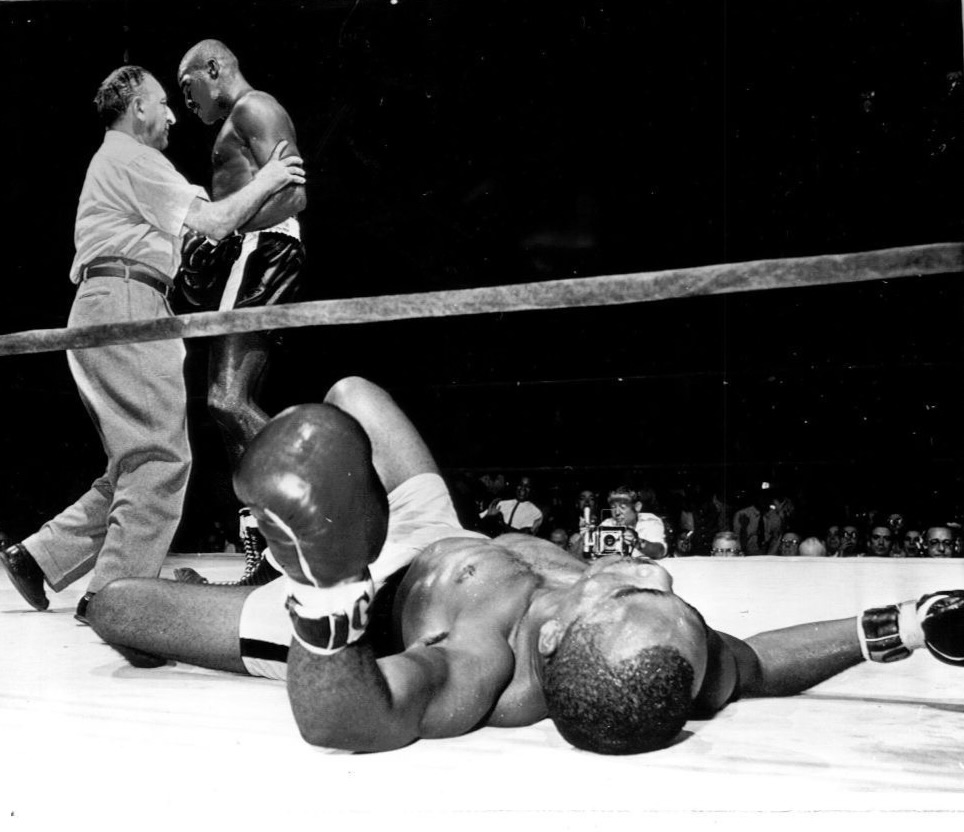
It was not only the blows Clay took from Jones but also the toll that had been exacted on him in his fights leading up to this bout. He was a young fighter who was brought along much too fast and was already getting burnt out at this point in his career. In the final 17 fights of his career, he lost 10. A sad ending for a promising fighter.
Ironically, Jones’s career began to follow the same path as Clay’s after their third bout. In his very next fight he was put in with Eddie Machen. Interestingly, Jones was originally slated to fight Harold Johnson, but Johnson pulled out due to an injury. Machen won a one-sided decision in the fight.
Jones would then fight Johnson in his very next bout. This was for the title, with Jones losing a one-sided 15-round decision. You’d think Jones would be given a rest after all of these tough fights, but no. Just three months later, on August 8, 1962, he was facing top heavyweight contender Zora Folley. Once again, Jones lost though this fight was closer, with Zora winning a 10-round decision. Just a month later, Jones faced Erich Schoppner in Europe, resulting in a draw.
A month after that, he returned to New York and defeated the young Bob Foster. His intense schedule continued without pause. Two months later, he fought Zora Folley again and, in a surprising upset, knocked him out in the seventh round.
This led to his fight with Cassius Clay on March 13, 1963. Jones matched Clay’s speed and challenged him throughout most of the bout. However, Clay secured a close decision victory by finishing strong in the last two rounds.
At this point in his career, Doug Jones had only had 26 fights but was battle-scarred. He had been in with formidable opposition and taken quite a few punches. In the third fight with Von Clay you can see the great ability Jones had. He was an aggressive boxer-puncher with great head movement and terrific combinations.
As good as he looked at that stage of his career, he was still developing and quite a ways away from being put in with the likes of Harold Johnson and Eddie Machen. If he had been guided more carefully, he very well might have beaten Cassius Clay in 1963. Alternatively, he also could have remained fighting as a light heavyweight and seen success in that division.
As good as he looked at that stage of his career, he was still developing and quite a ways away from being put in with the likes of Harold Johnson and Eddie Machen.
Unfortunately, Jones ended up becoming an opponent. He had name recognition because of the Clay fight, but he was pretty much through as a serious prospect. He had three wins after the bout with Cassius. In his fourth fight he lost a decision to Billy Daniels whom he had previously beaten. In his next fight he was kayoed by George Chuvalo.
The descent continued, with his only wins after that coming against second-raters. With losses to Ernie Terrell, Thad Spencer, Joe Frazier, and Boone Kirkman, Jones finally hung up the gloves in 1967.
Both Jones and Von Clay were talented and promising prospects. Their careers may very well have turned out quite differently if they had been managed better. Instead, they were thrown in for the quick money and never were able to fully develop. Unfortunately, their story was not an uncommon one in boxing.