

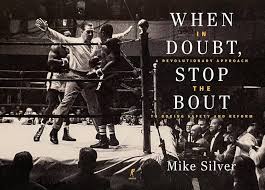
Review:
When In Doubt,
Stop The Bout
A Revolutionary Approach To
Boxing Safety And Reform
By Mike Silver
Hamilcar Publications
Reviewed By Bobby Franklin, December 2, 2025
It has often been said that unlike other sports, you don’t play boxing. True. Boxing is a unique competition in many ways, but there is one primary aspect of it that makes it truly different from other athletic endeavors; the requirement that in order to be successful, a boxer most become proficient at inflicting physical damage, even brain injuries, on his opponent. This some times leads to death, and more often, too often, to CTE (Chronic Traumatic Encephalopathy).
While it is true that participants in other sports, most notably football, also risk severe brain damage from concussive trauma, boxing is the only sport where success is measured by how well a person is able to become in causing physical harm to the person with whom he is competing. There is no getting away from this.
Can boxing be made safe? Not unless it is banned. Can boxing be made less dangerous? That is the question boxing historian Mike Silver tackles in his deep dive into reforming this hazardous sport in When In Doubt, Stop The Bout A Revolutionary Approach To Boxing Safety And Reform.
Mike has done extensive research into the subject of boxing safety. He has accumulated statistics dealing with the number of boxer deaths over the years as well as what effect the length of a fight has on increasing the risk of one or both of the participants being seriously injured.

Early in the book Mike comments on how the lack of regulation plays a role in putting the fighters at risk. He rightly observes that to become a boxing trainer in most locales around the world, all you have to do is walk into a gym, throw a towel over your shoulder and say you are a boxing coach. This is criminal. Young kids with an interest in boxing are put into a situation where when they first walk into a gym they are trusting someone who can get them killed. Where’s the oversight? There is none.
Mike spends time later in the book exposing the corruption higher up the ladder in the boxing world. From the alphabet soup organizations to promoters such as Don King. In 1997 King was inducted into the International Hall Of Fame, an action that speaks to just how low the standards are in boxing.
Reading about the sordidness and corruption in the sport may leave the reader with a terrible stench in his nostrils, but that is just one section of the book. Mike saves his best when offering up ways to mitigate the dangers faced by pugilists. They all have merit even though a few sound counterintuitive.
Take the case of the boxing glove. It has become dogma in the minds of most people that the padded covering for the hands prevents head injuries. Mike makes a strong case, one which I have long believed, that the glove actually makes the sport more dangerous and the blows more lethal. Once you read his argument you will see the boxing glove in a whole new light. Mike even quotes actor James Cagney on the subject.
His chapter contrasting MMA fighting with boxing is also an eye opener. Here is a sport that is perceived as more brutal than boxing, but, as the author points out, actually has many more safety measures built into it, and brain injuries are far fewer. Heavily padded boxing gloves are not used by the combatants, a point that bolsters Mike’s argument about the dangers of the boxing glove.
The most controversial, and most likely the change that would do the most good comes down to the author’s proposal to limit the rounds of fights. Many of us remember when title fights were scheduled for fifteen rounds. That was done away with after the death of Duk Koo Kim in a bout versus Ray Mancini in 1982. The fight was seen live on national TV. After that tragedy, title bouts were limited to twelve rounds.
Mike contends, today even twelve rounds is unsafe for most boxers. In years past fighters would slowly work their way up to longer duration matches by starting out in four rounders, then moving up to six, eight, and finally ten round bouts if they showed they had the ability to handle the distance. This was done over time. It was a sort of an apprenticeship approach.
Now, it is not uncommon to see fighters in their ninth or tenth fight challenging for a world title in a twelve round fight. Mike points out that no matter their physical conditioning, and these fighters are athletes, they have nowhere near the experience to handle going that distance. And the lack of experience is most notable in their lack of defensive skills. Boxing today is mostly about exchanging punches, basically fighters taking turns hitting each other in the head. It is no longer the Manly Art Of Self-Defense.
There is much more in this treatise on making such a dangerous sport less unsafe. Mike delves into training for referees, the role of the ringside doctors, when a fight be stopped (this is quite interesting), and the case for head guards.
This is an important book, one that should be read by members of every boxing commission, referees, physicians, and those with influence over the rules of boxing. Will that happen? It is unlikely.
Boxing has been around a long time, and while there have been some very decent people involved with the sort, it has also been a home to many lowlifes who don’t give a damn about the welfare of the men and women who step into the squared circle.
The fact that Mike is able to come up with so many reforms for boxing shows just what a mess the sport is and the danger it poses for healthy young athletes.
My take away from this book, one not intended by Mike, is the conclusion that reforming boxing is a lost cause. Not because his proposals aren’t valid, they certainly are, but rather because the swamp that is boxing will look to bury his work. I do urge people to delve into this highly readable work and draw their own conclusions. In a sane sport, Mike Silver would be garnering praise for his dedication and research into finding a way to fix boxing and protect the athletes. However, boxing is far from a sane sport, and a good man who truly cares for the welfare of it’s participants will most likely be shunned.
I hope I am wrong, and maybe if enough people read When In Doubt, Stop The Bout, it will lead to a discussion that will lead to lessening the terrible injuries inflicted upon those who step into the ring.