

Heavyweight Champ Fought Top Middleweights In Early Years Of His Career
By Bobby Franklin

Jimmy Ellis is best remembered for his career as a heavyweight. In 1968, he defeated Jerry Quarry in the final match of the WBA tournament to crown a successor to Muhammad Ali. Ali had been stripped of his title by the various boxing commissions and sanctioning organizations because of his refusal to join the military (Ring Magazine was the notable exception, continuing to list Ali as Champ in their ratings).
What is overlooked is Jimmy’s career as a middleweight. He began fighting professionally in the lighter division, debuting in 1961 when he kayoed Arley Seifer. That fight was the beginning of a 20-fight run as a middleweight, during which he fought many of the top contenders.
Ellis was not managed very carefully during that time. He was put in with much more experienced pros early on. In just his fourth fight, he was matched with Wilf Greaves, a veteran who had 54 fights. Greaves had beaten Charley Cotten and Dick Tiger. He also broke Gene Fullmer’s jaw in a fight where he lost a very close decision. Ellis lost a majority decision in the fight.
Just two fights later, he was tossed in with Holly Mims. With 84 fights under his belt at that time, Mims was a cagey fighter who outboxed Ellis over ten rounds.
Ellis’s opponents at that point had a total of 255 fights, while Jimmy had six or less. None had a losing record. This was all in his first year as a professional
Ellis’s opponents at that point had a total of 255 fights, while Jimmy had six or less. None had a losing record. This was all in his first year as a professional. At this point in his career, a talented young fighter should have been guided carefully to develop his skills and confidence. Instead, he was tossed in with whomever the promoters offered.
Ellis could have ended up ruined, but he was a survivor. In 1962, in his seventh fight, he beat Rory Calhoun, a fighter with a record of 45/14/2. That year would prove to be a good one for the young middleweight as he won seven fights, including a win in a rematch with Mims. His only loss was by decision to Henry Hank.
After the loss to Hank, Jimmy laced together a few more wins before losing a one sided decision to Rubin Hurricane Carter. At this point, his career seemed to have peaked, and he was looking to be more on the road to being an opponent than a contender. Jimmy closed out 1964 with losses to Don Fullmer and George Benton. Both fights were close, but not the wins he needed to move forward. What happened next was surprising and life-changing for Ellis.

Jimmy had been plagued with chronic tonsillitis for years. In 1965 he had them removed. After the surgery he began to put on weight. He was not getting fat. For some reason the surgery had changed his metabolism and he began to build up muscle. For the Benton fight he had weighed 160 pounds. In his next fight, just five months later, Ellis was up to 176 pounds. By the start of 1966 he had grown into a heavyweight.
Not only had Jimmy Ellis gotten bigger, he also went on a winning streak that would lead him to the WBA Heavyweight title. In fact, he would remain undefeated for the next five years. It wasn’t until 1970 that he would lose, and that was to Joe Frazier.
Jimmy was able to retain his middleweight boxing skills while facing the bigger men. He scored wins over Billy Daniels, Johnny Persol, Leotis Martin, Oscar Bonavena, Jerry Quarry, and Floyd Patterson. Ellis also retained his punching power. He was able to floor the rock-chinned Bonavena in their fight, something Joe Frazier couldn’t do in two fights against the Argentine.
Why was Ellis so much more successful as a heavyweight than he was when fighting in the middleweight division? The answer lies in his ability to retain his middleweight boxing skills. His speed and accuracy were not unusual when fighting the smaller men, so it was not a great advantage as his middleweight opponents possessed those same attributes.

Jimmy’s weight gain while unusual was natural. He didn’t bulk up by lifting weights or using steroids. His body had a natural reaction to his tonsillectomy. Yes, Ellis would have slowed down a bit from his time as a middleweight, but he was still much faster and sharper than the vast majority of heavyweights. He had also honed his boxing skills against men like Benton and Mims.
The fact is, most heavyweights were not very good boxers. The best were the ones who started out in smaller weight divisions and never got really large. Ellis is a fine example of this. The most successful heavyweights were those who could fight with the skills of middleweights. Speed and accuracy are always important in a fighter. In a heavyweight those skills made an enormous difference. Dempsey, Tunney, Louis, and the young Ali dominated because they fought like middleweights. While Jimmy Ellis would not be considered an all-time great, he was still hugely successful. Had he stayed fighting as a middleweight he never would have gone to the top, but as a heavyweight he was a force to reckon with.
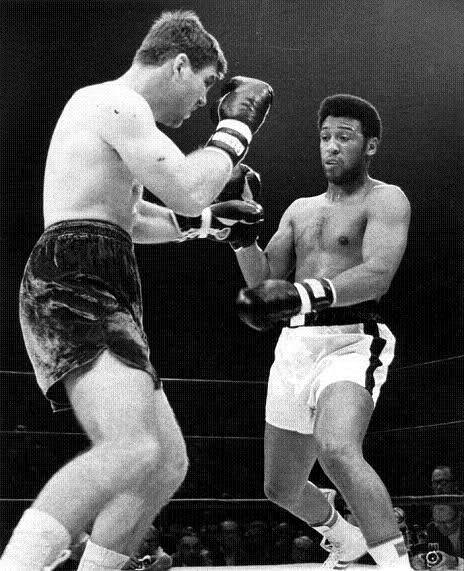
After his loss to Frazier, Ellis started working his way back to a title shot. He defeated Roberto Davila, Tony Doyle, and George Chuvalo before facing his old friend Muhammad Ali in 1971. Jimmy was stopped in the twelfth and final round of that fight.
Jimmy once again worked his way back into contention winning eight straight fights over the next two years. Most of these fights were against opponents and journeymen.
In 1973 he stepped in with Earnie Shavers at Madison Square Garden. A win would put him back into title contention. At the opening bell Ellis came out and took the fight to Shavers. Earnie was hurt, and it appeared he might be on the way to being kayoed when he caught Jimmy with a powerful right uppercut that put Ellis on the canvas for the ten count.
Jimmy Ellis would have another seven fights before calling it quits. Out of the seven, he had only one win. He retired in 1975 after losing the sight in one of his eyes.
Historically, Ellis is underrated. He was an outstanding boxer/puncher who went far. His career is all the more remarkable when considering that he was fading as a middleweight, yet he was able to resurrect his career and become a heavyweight champion.
In his peak years in the heavyweight division his only losses were to Joe Frazier and Muhammad Ali. As a middleweight Jimmy had 15 wins and five defeats. As a heavyweight, he went 24 and 7 with one draw. Most of his heavyweight losses were at the end of his career.
On May 6, 2014, suffering from dementia brought on by his years in the ring, Jimmy Ellis died at the age of 74.


