

Was Braddock’s Last Fight About Protecting
His Investment?
By Bobby Franklin 2.16.2025

A few years ago I wrote about the career of Tommy Farr and speculated on the reasons he was never given a rematch with Joe Louis.Link Here Farr had been the first man to challenge the Brown Bomber, and he gave the champion a go of it, extending Joe the full fifteen rounds. While Tommy wasn’t robbed, the fight was closer than most expected. The fact that Farr was still standing at the final bell earned him the respect of the fans and a second fight would certainly have drawn a crowd.
Of course, in that era fighters weren’t automatically given a second shot at the title. They had to beat another contender to earn their chance. Even Jack Dempsey had to defeat Jack Sharkey before being allowed to fight Gene Tunney a second time.
At first glance it appears the choice of James J. Braddock for a matchup with Farr makes sense. In Braddock’s last fight he had lost the title to Louis. In Jimmy’s case he was kayoed, so it was pretty decisive and the public was not clamoring for a rematch. But the match was still logical. It could also be assumed by the Farr team that Tommy would beat Braddock and then move on to a fight with Louis.
Things didn’t turn out as planned, or did they?
As I pointed out in my earlier article, the Louis fight was Tommy’s first appearance in the States. He was a bit naive about how the boxing game worked in this country at that time. He also didn’t know that in order for Louis to get the shot at Braddock, Louis’s managers had to guarantee Jimmy 10% of future earnings should Joe win the title. It was in Jimmy’s interest to have Joe remain champion for as long as possible. Off of Farr’s performance against Louis, Joe Gould, Braddock’s manager, could have seen Farr as a threat to that income. While a Farr return fight with the champ would have drawn a decent gate, the huge money was in Joe’s rematch with Max Schmeling who had kayoed him before he won the title. That fight was being negotiated at this time.
You can see there were some extenuating factors involved in the Farr/Braddock fight. It’s quite possible Jimmy’s management wasn’t confident he could beat Farr. However, if Jimmy lost, Farr would most likely get his Louis rematch. Alternatively, they could refuse the match and Farr could go on to beat another contender and earn his title shot.
So what other choices were there? Joe Gould, Braddock’s manager always had something up his sleeve. Contrary to the nice guy image of Gould portrayed by Paul Giamatti in the movie Cinderella Man, Gould was a shady character. He knew how to navigate the dark side of boxing.
Recently, I watched the existing footage of the Braddock/Farr fight. All ten rounds are available but are truncated. You can see about one to two minutes of each round. While not an exciting fight, it is interesting to watch against the backdrop of all that was at stake then.
The fight took place on January 21, 1938 at Madison Square Garden before a little over 17,000 fans. This was about six months after Braddock lost the title to Louis, and five months since Farr fought the champ. It would be Braddock’s final appearance in a boxing ring.

At the opening bell both men came out using decent left jabs. Farr was faster on his feet and moved in and out. Jimmy was content to stay at long range and would grab and hold whenever the two got to close quarters. The fact that Braddock was content to stay at distance also meant that his right hands were falling short of their mark. Why didn’t he step in more when throwing those rights? Why was Jimmy reluctant to mix it up inside? Farr wasn’t known as a tremendous puncher.
To me it looked like Braddock didn’t want to take any chances on getting kayoed. He was a man intent on going the distance. By grappling with Farr on the inside he turned this into a fairly boring fight, one that makes both fighters look bad.
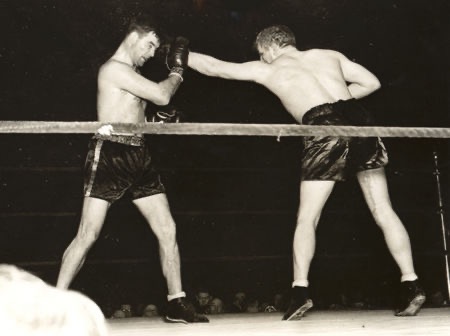
At the final bell, Braddock’s hand was raised in victory, though the crowd did not approve. Tommy, who never complained when he came up short against Louis, was incensed over the verdict. He said “I was bloody-well robbed. I’ll get him again and a decision won’t be necessary.”
Farr never did get a rematch with Braddock. Jimmy retired after the fight content to collect on the revenue from Joe Louis’s fights. Incredibly, Joe Gould took over as Tommy’s manager. As I said, Farr was very naive about the boxing business on this side of the pond. His career was all downhill in the hands of the ruthless Joe Gould.
I believe the decision in the Farr/Braddock fight was preordained. It was the perfect outcome for Braddock. He and Gould threw a wrench into any chance of a Louis/Farr rematch, thus protecting their investment. Gould had the where withal to influence the judges.
It has to be remembered that this all took place during the Depression. Boxing was a rough business. Fighters were in the profession to make money. Winning fights and titles was secondary. Lots of deals were made during that period. Braddock had a family to feed and they came first.
It is interesting to note that while being managed by Joe Gould, Tommy Farr lost every fight he had. In fact, Farr never won a fight in the United States. He lost to Louis, and then was beaten by Max Baer a fighter he had handled easily a year earlier. He then went on to lose decisions to Lou Nova and Red Burman before returning home to Wales.
Back with his original management, he now returned to his winning ways. He fought a rematch with Red Burman getting the nod over twelve rounds. He then went on to beat Larry Gains, Manuel Kid Abrew, and Zachary Nicholas. At this point with WWII raging in England, Tommy retired. He did make a comeback in 1950 but that didn’t go anywhere.
I don’t fault Jimmy Braddock for any of this. He was one of the few to come out of boxing with money and his brains intact. Joe Gould on the other hand was a real sleaze.
While Tommy Farr was a stand up guy, his decision to leave his Welsh manager Joby Churchill and go with Joe Gould was a catastrophic mistake. For all I know, Churchill may have encouraged him to do this believing Gould would be able to open doors for him. Instead, he got the door slammed on his career.