

Review:
Cleveland Arena
Ohio’s Professional Boxing Mecca
1937-1973
Arcadia Publishing
By Jerry Fitch
Reviewed by Bobby Franklin March 16, 2025
It’s hard to believe today in this age of pay-per-view boxing, but there was a time when people would actually go on a regular basis to a local venue to watch live in-person boxing matches. Most cities, and even smaller municipalities had places where fights were held frequently. The 1930s and 1940s were really the heyday for well attended local fight cards.
In the 1950s, with the advent of television and with most homes having a TV set, the smaller fight clubs were being hurt. Not only were fights being broadcast up to four times a night weekly, but there were plenty of other popular televisions programs that had people hooked. This alternative also cut into other entertainment business such as movie theaters and nightclubs, but I would argue boxing was hit the hardest.
One by one the smaller clubs started to disappear. Not only was the lack of paying customers causing a problem, but the people promoting the televised fights were moving fighters along quickly in order to keep their fight schedules filled. This resulted in many boxers being put in over their heads early in their careers, resulting in their never being able to develop to their full potential.
The lack of local venues also meant less opportunities for those just starting out to find work. Because of this, many boxing gyms disappeared as well. The lack of gyms resulted in their being fewer and fewer boxers able to move up into the professional ranks. This shortage would eventually take its toll on the televised fights. The weekly TV fight cards started to be cut.
Today, boxing is run more as an entertainment industry, or perhaps more in line with something like professional wrestling. It is driven by social media and marketing experts. Fans will pay to watch hyped up fights on pay-per-view, but most don’t follow closely the careers of the participants, especially from their early careers. They are sold on the hype. The sizzle, not the steak.
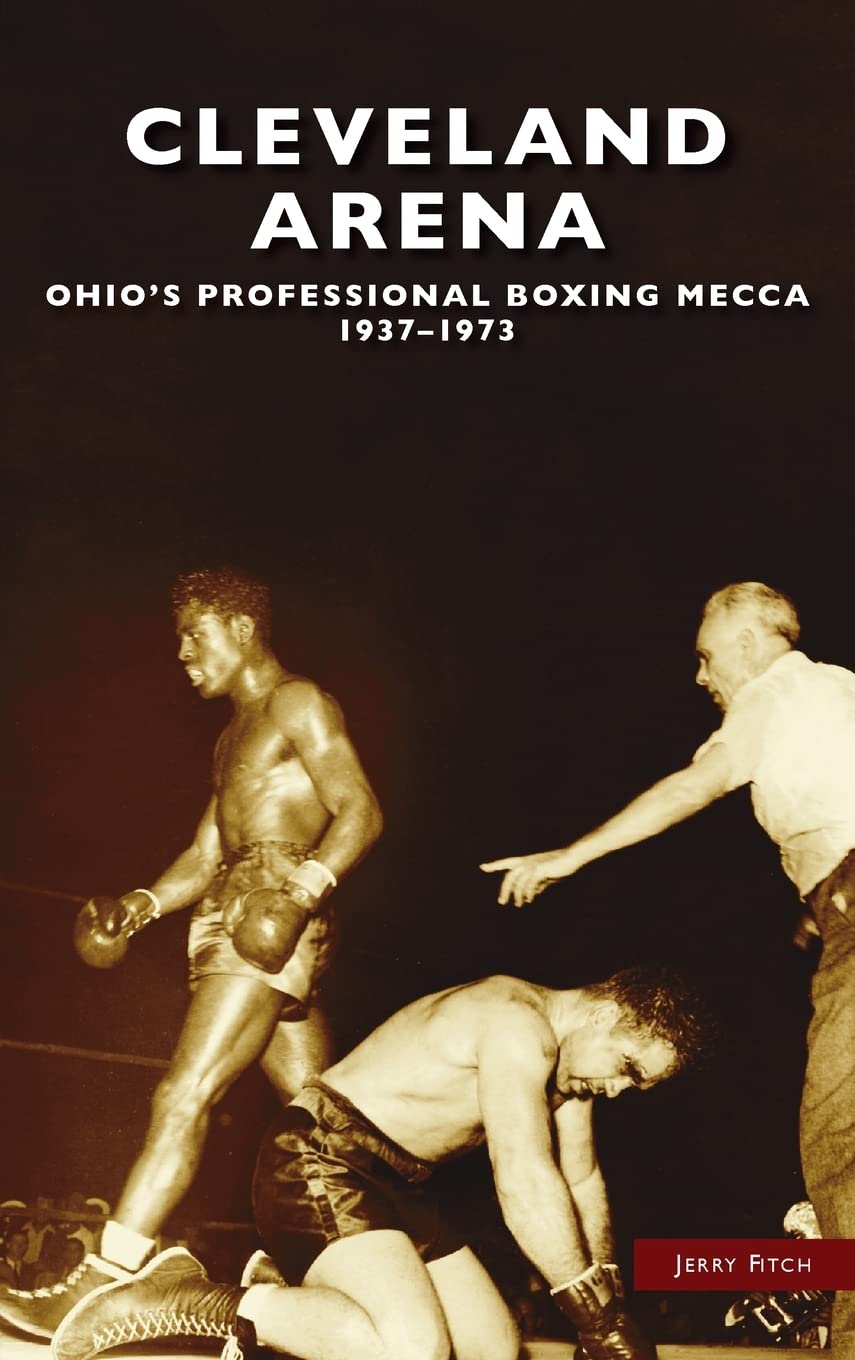
 Reading boxing historian Jerry Fitch’s book Cleveland Arena: Ohio’s Professional Boxing Mecca 1937-1973, brings us back to that time when fight fans could buy a reasonably priced ticket to see highly talented fighters compete. Undercards would often showcase local up and comers while the semi final and main events would consist of solid pros in competitive contests.
The Cleveland Arena with a seating capacity of 14,000 for boxing was one of those places. It was in operation for 36 years, and the rise and decline of boxing is mirrored in it’s history.
Mr. Fitch has compiled a complete listing of every card that took place in this storied location. In this beautiful book he has supplemented his listings and brief commentaries on these cards with an incredible collection of photographs of the fights and fighters who fought there. The photos are from the author’s personal collection as well as from the archive of the Cleveland Plain Dealer. Many of these photos will be new to long time fight fans, and are to be treasured.
The list of great and near great fighters who fought at the Arena is endless. There are also some interesting things to note. In particular, Jake LaMotta fought there four times but had only one win, that being in his final fight at the venue.
In the 1930s when the Arena was first in operation, had you been attending shows you would have gotten to see Henry Armstrong make three title defenses.

The Cleveland Arena really hit its stride in the first half of the 1940s. From 1940 to 1944, all-time great Jimmy Bivins headlined 23 cards. Others to step into the ring during this period were Tami Mauriello, Lloyd Marshall, Ezzard Charles, Abe Simon, Billy Soose, and Joey Maxim to name just a few. It is staggering to think that if you lived in the Cleveland area at that time you could have purchased a reasonably priced ticket to see this remarkable talent in person.
Mr. Fitch chronicles this history with precision along with the affection he has for the sport that he has followed since he was very young. Over his lifetime he has met just about every noted boxer as well as becoming close friends with many, most notably Jimmy Bivins.
The book takes us on a thrilling ride, with the excitement of those early years leading to the sadness of seeing the local boxing scene start to fade in the 1960s, with only 11 shows being promoted in that decade.That was quite a drop from the 37 shows held in the 1950s. This decline was not confined to Cleveland. It was happening all over the country. Fight fans attending Cleveland Arena fight cards still got their money’s worth in those final years as they saw cards headlined by the likes of George Chuvalo, Zora Folley, Joey Giardello, and Doyle Baird.
1973 saw the last of the promotions at the Cleveland Arena. Local boxing was on its last legs by then, and there was no stopping the inevitable. The remaining cards headlined some future contenders and champions such as George Foreman, Ken Norton, along with former champs Floyd Patterson, Emile Griffith, and Ernie Terrell. Boston boxing fans may also remember that one of our own, Mike Pusateri traveled to Cleveland to beat local favorite Doyle Baird. Baird came back to defeat Iron Mike in two rematches. All three were very exciting fights.

Jerry Fitch’s history of the Cleveland Arena is a must have for any boxing library. The historical information is invaluable, and the photos are something to be treasured. This is not a volume to remain on the shelf, but one to be left out where it can be perused over and over. While dipping into it you can close your eyes at times and hear the roar of the crowd and smell the cigar smoke that was ever present in those days gone by. It was quite different from sitting on your sofa watching fights on a big screen TV.
While Jerry has worked tirelessly to bring those days back to us, I think I would add a final line to this volume; “You had to be there!”
Copies of the book may be purchased directly from Jerry Fitch. His email is Jerryfitch1946 [at] gmail [dot] com


